
The average smartphone buyer in India is a nightmare for a linear marketing funnel. They start with a 15-second reel on Instagram, move to a technical deep-dive on YouTube, and then pivot to Reddit to see if the battery actually lasts as long as the brand claims. If you are coordinating Digital Marketing in Chennai, you realize that a lead is never a single-touch event. For Infinix, which competes in a hyper-aggressive budget and performance bracket, the purchase journey is fragmented across a dozen touchpoints. Search is the only thing that holds these pieces together. Without a coherent strategy, you are just spending money on social ads to drive traffic to your competitors’ review pages.
Most brands treat search as a bottom-of-the-funnel tool. They focus on transactional intent. But in a complex ecosystem, Multichannel marketing requires search visibility at the awareness stage just as much as the checkout stage. If a user sees a “Zero 30” ad but can’t find a localized review or a comparison table when they search for it later, that ad spend is wasted. SEO is the connective tissue. It ensures that, regardless of where the customer starts, they always find a path back to your controlled narrative.
The Fragmented Nature of the Multichannel Customer Journey
A user’s path from “I need a new phone” to “Payment Successful” is rarely a straight line. The multichannel customer journey is a series of loops. A buyer might see a gaming benchmark of an Infinix Note series device on a tech forum, then search for it on a retail site, and then go back to Google to look for “Infinix service centers near me.” Each of these steps is a search event. If your SEO is only optimized for “buy smartphones online,” you are missing the middle 70% of the conversation.
We see this most often in the comparison phase. Buyers don’t just search for your product; they search for your product vs the market leader. A robust SEO strategy for multichannel marketing involves creating content that answers these “Versus” queries. You have to be the one defining the comparison. If you leave it to third-party affiliate sites, you lose control of the technical nuances that make your hardware superior. You need to provide the data that the customer uses to justify their decision.
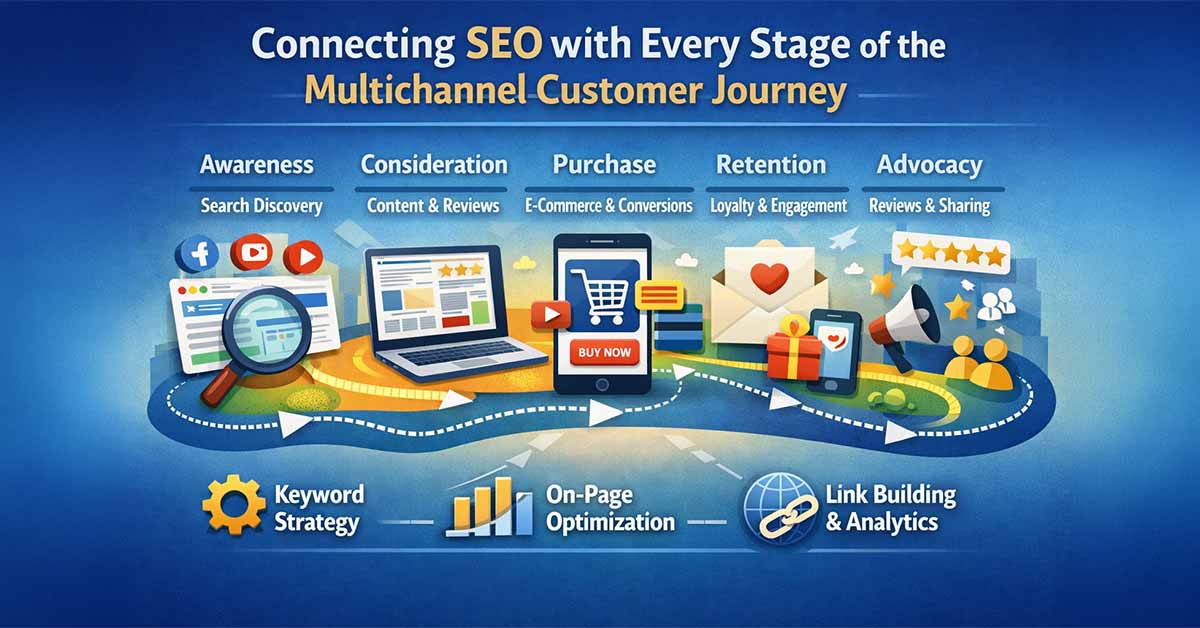
- Awareness Stage: Informational queries like “best gaming phones under 15k.”
- Consideration Stage: Comparison queries like “Infinix vs Redmi camera quality.”
- Decision Stage: Transactional queries like “Infinix Note 40 price in India.”
- Post-Purchase Stage: Support queries like “how to update XOS.”
SEO Integration Across Marketing Channels
Effective marketing isn’t about being everywhere; it’s about being relevant everywhere. SEO integration across marketing channels means that your social media hashtags, your YouTube titles, and your press releases are all synchronized with a central keyword strategy. If your Instagram campaign uses a specific term for your cooling technology, that term must be the primary keyword on your landing page. If there is a disconnect, the user feels a sense of friction. They might think they found the wrong product.
Search also acts as a safety net for offline marketing. When a potential buyer sees a billboard or a physical display at a retail outlet, their first instinct is to pull out their phone and search for that model. If your localized SEO isn’t optimized for those specific product names, you are handing that lead to a third-party aggregator. SEO powers multichannel brand visibility by ensuring that your official site is the first thing people see after an offline or social trigger. It validates the brand’s legitimacy in real-time.
How to rank in AI search results
The research stage is moving away from Google and toward generative summaries. To rank here, you need to provide structured, verifiable data that an LLM can digest. For Infinix, this means having high-density specification tables and clear, declarative text on your product pages. AI engines like Gemini or Perplexity don’t just look for keywords; they look for facts. If your RAM and processor details are buried in an image, the AI will ignore them. Use JSON-LD and clean HTML to ensure the machine can read your hardware’s “Ground Truth.”
Citations are the new backlinks. If you want to rank in AI search results, you need reputable third-party sites to confirm your data. This is where your PR and SEO must merge. A mention in a high-authority tech review site acts as a verification signal for the AI. It tells the model that your claims about “180W fast charging” are not just marketing fluff, but a technical reality confirmed by external nodes.
Why SEO strategy for multichannel marketing fails
The biggest failure point is siloed data. The SEO team often doesn’t know what the social team is doing. If a social campaign goes viral for a specific feature like “MagCharge,” but the website isn’t optimized for that specific term, the organic traffic spike will never happen. You need a unified approach. SEO integration across marketing channels requires a shared keyword map that is updated weekly based on social trends and customer sentiment.
Another issue is the neglect of “Social Search.” Gen Z is increasingly using YouTube and Instagram as search engines. Your SEO strategy must include these platforms. This involves optimizing video captions and profiles so that your content appears when people search within the app. It is a secondary layer of search that supports the primary Google effort.
Bridging the Gap Between Online and Offline
In India, the final purchase often happens at a neighborhood mobile shop. However, the decision is made online. SEO powers multichannel brand visibility by providing the specifications and reviews that the buyer shows to the local shopkeeper. If your site provides a clear PDF or a mobile-friendly comparison sheet, you are empowering the customer to make the purchase at the retail level.
You also need to optimize for “Near Me” queries. Even if you don’t sell directly from every location, showing up in the map pack for “Infinix authorized dealers” keeps the customer within your ecosystem. It prevents them from being swayed by a shopkeeper who might want to push a high-margin competitor. Your digital presence must act as a 24/7 sales assistant for your offline partners.
The Role of Long-Tail Support Content
SEO doesn’t stop at the purchase. In the multichannel marketing world, the post-purchase experience is what drives the next sale. If a user has a problem and finds an official, easy-to-follow solution on your site, their brand loyalty increases. If they only find complaints on forums, they will switch brands for their next upgrade.
Ranking for XOS “how-to” queries offloads pressure from your support teams. It turns your documentation into an authoritative search asset. This long-tail traffic isn’t looking for a phone; they already own one. Providing answers on your official site prevents them from wandering into forums where competitors often dominate the conversation. Utility is the foundation of retention.
Finalizing the Multichannel SEO Framework
A successful strategy is never “finished.” It is an iterative process of listening to how users search at different times. During a launch month, the focus shifts to broad awareness and specs. During a festive sale, the focus shifts to price comparisons and bank offers.
If your team is only focusing on one-off optimizations, they are missing the forest for the trees. To truly dominate the Indian market, you need a partner that can synchronize your technical SEO with your broader market objectives. For businesses in the region, investing in professional Digital Marketing in Chennai provides the localized insight required to navigate these complex, multi-touch journeys. The internet is no longer a collection of sites; it is a stream of information. Your goal is to ensure your brand is the most visible and reliable part of that stream.