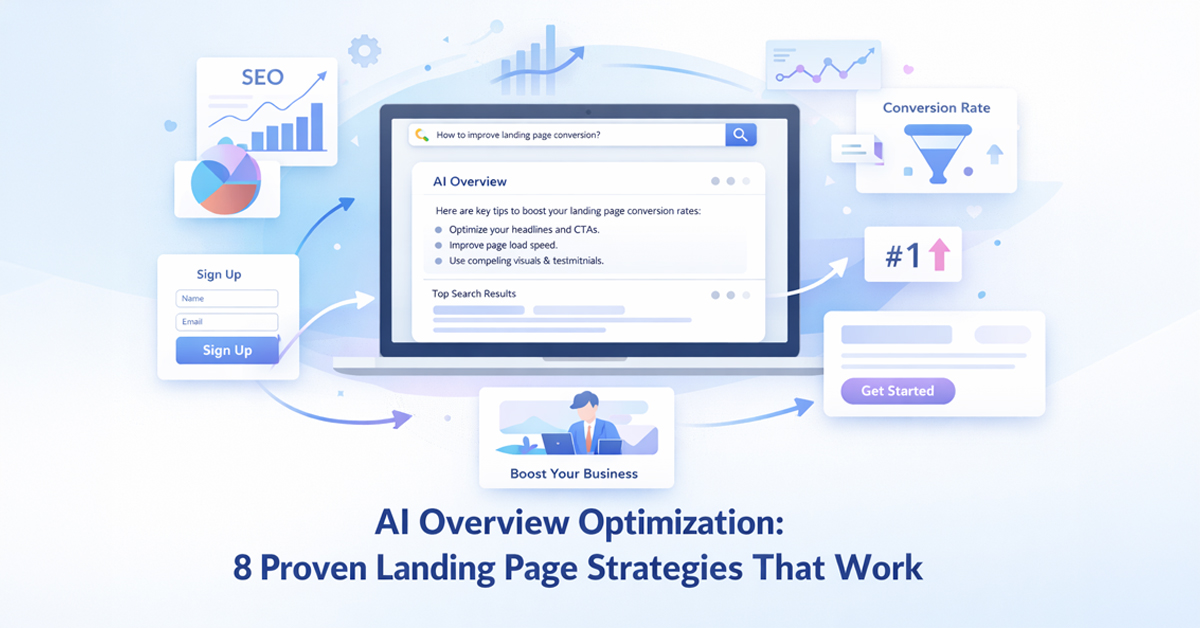
Google’s AI overviews have changed something fundamental about how people interact with search results. A user types a query, and before they even see the list of blue links, Google hands them a synthesized answer pulled from pages it considers authoritative, well-structured, and genuinely useful. For businesses, this means the rules around landing pages have shifted. Pages that were optimized for a 2022 search engine are not the same pages that get cited in a 2025 AI overview. If your landing pages aren’t built with AI overview optimization strategies in mind, you’re competing for clicks that are already being absorbed higher up the page. Whether you’re working with a team or going at it yourself, these eight strategies are what SEO services in Chennai practitioners are applying right now to get pages cited and clicked.
AI Landing Page Optimization for Leads
Getting cited in an AI Overview isn’t purely a vanity metric. When Google references your page in a generated answer, your brand name appears before the user has clicked anything, and that kind of visibility shapes buying decisions faster than a tenth-position organic ranking ever could. The strategies below are built around one goal: making your landing page the kind of source Google’s AI wants to pull from when a relevant question gets asked.
1. Answer the Question in the First 100 Words
AI models scan for direct answers, and they find them near the top of the page. If your landing page buries the core value proposition three scrolls down, behind a hero image and a tagline, the AI has already moved on. Open with a clear, specific statement of what the page is about and what problem it solves. Think of it as writing for someone who has five seconds, because in AI-driven search, the model scanning your page effectively does.
2. Use Structured Headings That Mirror Real Questions
The heading structure on your page does more work in the AI-era SEO than most marketers realize. Headings formatted as questions (or clear answers to questions users actually ask) make it easier for AI systems to extract your content as a cited response. If someone searches “how to choose an SEO agency in Chennai,” a heading on your page that reads “What to look for in an SEO company” gives Google’s AI a clean, extractable answer to work with. AI overview optimization strategies begin at the structural level, not at the keyword density level.
3. Build for E-E-A-T, Not Just Keywords
Google’s AI pulls from pages it considers credible. Experience, expertise, authoritativeness, and trustworthiness (E-E-A-T) are not abstract quality guidelines. They’re signals Google’s systems actively evaluate. On a landing page, that means showing real results (client numbers, case studies, measurable outcomes), naming the people or team behind the service, and including proof that the claims you’re making have been verified somewhere outside your website. A landing page that says “we’re the best” with nothing behind it gets ignored. A landing page that shows 60x traffic growth with a named client gets cited.
4. Write for the Featured Snippet and the AI Box Simultaneously
Featured Snippets and AI Overviews often pull from the same pages. The format that wins both is remarkably consistent: a direct one-to-two-sentence answer to a question, followed by a short supporting paragraph, followed by a list or structured breakdown. Pages that follow this pattern on key sections get picked up disproportionately often. For AI-friendly landing page design, think in blocks: question, answer, and expansion, rather than in long unbroken sections of marketing copy.
5. Keep the Page Fast, Crawlable, and Technically Sound
Landing pages with slow load times, broken internal links, or blocked JavaScript give AI crawlers less to work with. Landing page optimization for AI-driven search isn’t purely a content exercise. Core Web Vitals, mobile performance, schema markup, and crawl accessibility all feed into how well an AI system can read and index your page. A technically sound page with average content will outperform a beautifully written page that loads in six seconds on mobile. That’s not an exaggeration.
6. Use Schema Markup to Give AI Systems Context
Schema markup tells search engines what type of content is on the page and how different elements relate to each other. For landing pages, FAQ schema, service schema, and LocalBusiness schema are particularly useful because they give AI systems structured data to work with rather than requiring them to infer meaning from prose. If your page doesn’t have schema, adding it is one of the faster wins available in landing page optimization for AI-driven search without needing to rewrite any visible content.
7. Write Conversationally, Because AI Searches Are Conversational
The queries triggering AI overviews are rarely short. Users ask full questions: “what’s the difference between SEO and PPC?”, “How long does SEO take to show results”, “Which digital marketing agency in Chennai handles content-based SEO”. Pages that write in the same register as these questions, in direct, clear prose rather than keyword-stuffed paragraphs, align more naturally with how AI systems process and surface content. Generative AI search optimization is not about tricking an algorithm; it’s about writing pages that genuinely answer what someone is asking in the language they used to ask it.
8. Optimize for Multi-Step User Intent
Most visitors landing on a service page haven’t made a decision yet. They’re comparing options, researching, or trying to understand whether something fits their situation. A landing page built for generative AI search optimization accounts for all three of these stages on the same page: it answers the “what is it” question, addresses the “is it right for me” question, and makes the “how do I get started” step obvious. Pages that handle this sequencing well tend to both rank better and convert better, because the same clarity that AI systems favor is the same clarity that turns a visitor into a lead.
What This Looks Like in Practice
The businesses that are getting cited in AI overviews today aren’t necessarily the ones with the highest domain authority. They’re the ones with pages that are structured clearly, answer real questions directly, load fast, and carry enough credibility signals to be trusted as a source. That’s a combination of content quality, technical hygiene, and positioning, which is exactly what a well-rounded SEO strategy is supposed to deliver.
If you’re unsure how your current landing pages hold up against these criteria, the starting point is an honest audit. How does the page open? Does it answer a specific question within the first paragraph? Are the headings usable as standalone answers? Is there a schema? Does it load in under three seconds on mobile?
Most pages fail at least two or three of these, and fixing them doesn’t require a full rebuild. It requires knowing what to look for, and that’s where working with a team that stays current on how AI-driven search actually behaves makes a meaningful difference. infiniX360 is built around exactly this kind of content-first, technically sound approach, refined over 15 years and across 500+ clients in 50+ industries.
The Real Goal: Be the Source, Not Just a Result
Search is no longer just about ranking on page one. It’s about being the source an AI system reaches for when someone asks a question your business should be answering. Getting there takes more than keywords. It takes pages built to be read, trusted, and cited. If your landing pages aren’t there yet, the digital marketing company in Chennai that can close that gap is closer than you think.