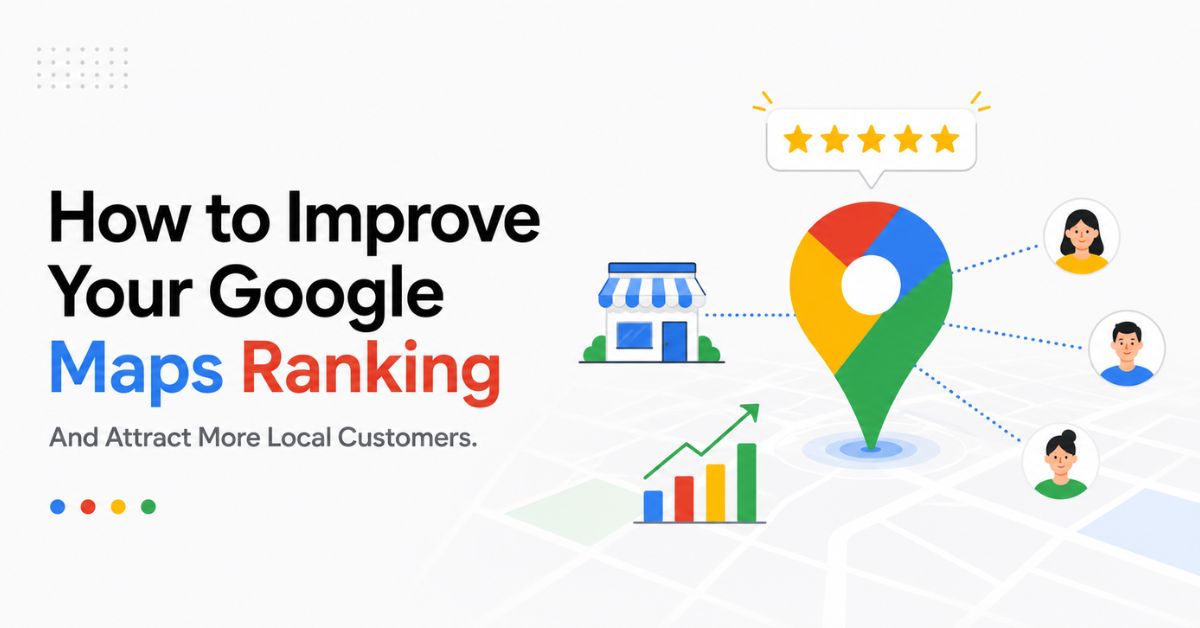
Picture this: someone in your neighborhood searches “plumber near me” or “best bakery Chennai”, and three businesses show up in that little map pack at the top of the results. If you’re not one of them, you’ve basically vanished from that customer’s decision-making process before they even open a website. That’s the reality of local search today, and it’s exactly why so many business owners come to us asking the same question: how do we actually move up in there?
We get this question constantly at our SEO company in Chennai, and the honest answer is that Google Maps ranking isn’t governed by luck or by whoever’s been in business longest. It runs on a specific set of signals that Google evaluates every time someone searches nearby, and most businesses are only optimizing for a fraction of them.
What Actually Determines Your Position on the Map
Google boils local ranking down to three core inputs: relevance, distance, and prominence. Relevance is how well your listing matches what someone searched for. Distance is exactly what it sounds like, though it matters less than most people assume, since Google will still show a slightly farther business if it’s a stronger overall match. Prominence is where most of the real work happens: how well-known and well-reviewed your business is on Google and across the web.
Understanding those three inputs matters because they map directly onto the local SEO ranking factors you can actually influence. You can’t move your office closer to every customer, but you can absolutely improve relevance and prominence, and that’s where the rest of this comes in.
Start With Your Google Business Profile
If you haven’t touched your Google Business Profile since you first set it up, that’s probably costing you more visibility than any other single mistake on this list. Real Google Business Profile optimization starts with the basics done consistently, not a one-time setup you check off and forget. A profile that’s filled out, kept current, and actively managed sends a completely different signal than one that was created once and abandoned.
A few things worth checking today:
- Business name matches your shopfront signage and legal name exactly, with no extra keywords tacked on to try to game relevance, since Google now penalizes that rather than rewarding it.
- All relevant categories are filled in, not just one primary category. Most businesses set up one and never come back to add the secondary ones that actually describe half of what they do.
- Photos are current. If the ones on your profile are three years old, or worse, stock images instead of your actual location and team, swap them out.
- Hours are accurate, especially around holidays. A customer who shows up at a locked door because Google said you were open doesn’t come back.
This ongoing maintenance is what real Google Business Profile optimization looks like in practice. It’s not a one-time setup task you finish and forget; it’s closer to keeping a storefront window clean and current, something you’d never leave untouched for two years.
Reviews Carry More Weight Than Most Businesses Realize
Review count, review recency, and your response rate all factor into how Google ranks your listing, and it’s one of the fastest levers most businesses ignore. Reviews sit near the top of the list when you look at which local SEO ranking factors businesses can actually influence in a matter of weeks rather than months. A business with 40 recent, detailed reviews will typically outrank a competitor sitting on 15 reviews from three years ago, even if that competitor has a slightly better overall rating.
The businesses that consistently rank well tend to do a few things without exception:
- They ask for reviews right after a positive interaction, rather than hoping customers remember to leave one later on their own.
- They respond to every review, not just the negative ones. A thoughtful reply to a five-star review shows Google, and future customers, that someone’s actually paying attention.
- They never buy or fake reviews. Google has gotten remarkably good at detecting patterns that look manufactured, and the penalty for getting caught outweighs any short-term bump.
Local Citations and Consistency Across the Web
A citation is any online mention of your business name, address, and phone number, whether on a directory site, in a local news article, or on a partner’s website. Google cross-references these citations to verify that your business is real, active, and located where you say it is.
The problem most businesses run into isn’t a lack of citations; it’s inconsistency between them. Citation consistency is one of the quieter local SEO ranking factors, easy to overlook because no single mismatch feels significant on its own. An old address in one directory, a slightly different phone number in another, and a business name abbreviated differently across five sites all suggest that something is off. Auditing and cleaning up these details across your major directories is tedious, unglamorous work, but it consistently moves the needle more than business owners expect.
On-Page Signals Still Matter
Your website itself feeds into local rankings too, and it’s easy to forget this while focused entirely on the Business Profile. A few things to check on your own site:
- Your name, address, and phone number appear clearly on the site, ideally in the footer of every page, matching your Google listing exactly.
- A Google Map is embedded on your contact page, not just a written address.
- If you serve multiple areas, each location has its own dedicated page rather than sharing one generic contact page.
- The site loads quickly on mobile, since a slow local business site loses both rankings and impatient customers.
Building Location-Specific Content
Generic service pages rarely rank well for local intent. A plumbing company with one page titled “Our Services” is competing against businesses that have written dedicated content for “Emergency Plumbing in Velachery” or “Water Heater Repair in Adyar”. That specificity signals relevance in a way that broad, generic copy simply can’t.
This doesn’t mean stuffing every page with neighborhood names. It means genuinely addressing what a nearby customer actually needs to know: service areas, response times, pricing expectations, and the kind of specific detail that only comes from actually operating in that area.
Putting It All Together
None of these factors work in isolation, and that’s really the point. A perfectly optimized business profile sitting on a slow, generic website with inconsistent citations still won’t rank the way it should. Even flawless Google Business Profile optimization can’t compensate for weak signals everywhere else. Relevance, prominence, and consistency all pull in the same direction; otherwise, none of them does much good on its own, so the real work is getting all three moving together instead of fixing one and calling it done.
We’ve seen plenty of businesses chase a quick win, patch up their profile once, and then wonder six months later why a newer competitor passed them. Treat your Google Maps ranking as something you maintain quarterly, not something you fix once and walk away from. If keeping up with all of this feels like more than your team has bandwidth for, that’s exactly the kind of work a specialized partner in digital marketing in Chennai handles day-to-day, so your business stays visible to the customers searching for you right now, not just the ones who happened to find you last year.