Google Ads has never stood still. But the shift that happened when AI bidding became mainstream was different from previous updates. It didn’t just change how bids were placed. It changed who was competitive and who wasn’t. Businesses that understood the mechanics got more from their budgets. Those who ignored it kept paying for the same results while the floor kept rising. If you’re running paid campaigns in 2026 and still relying on manual bidding, this blog is worth your time.
What Is AI Bidding?
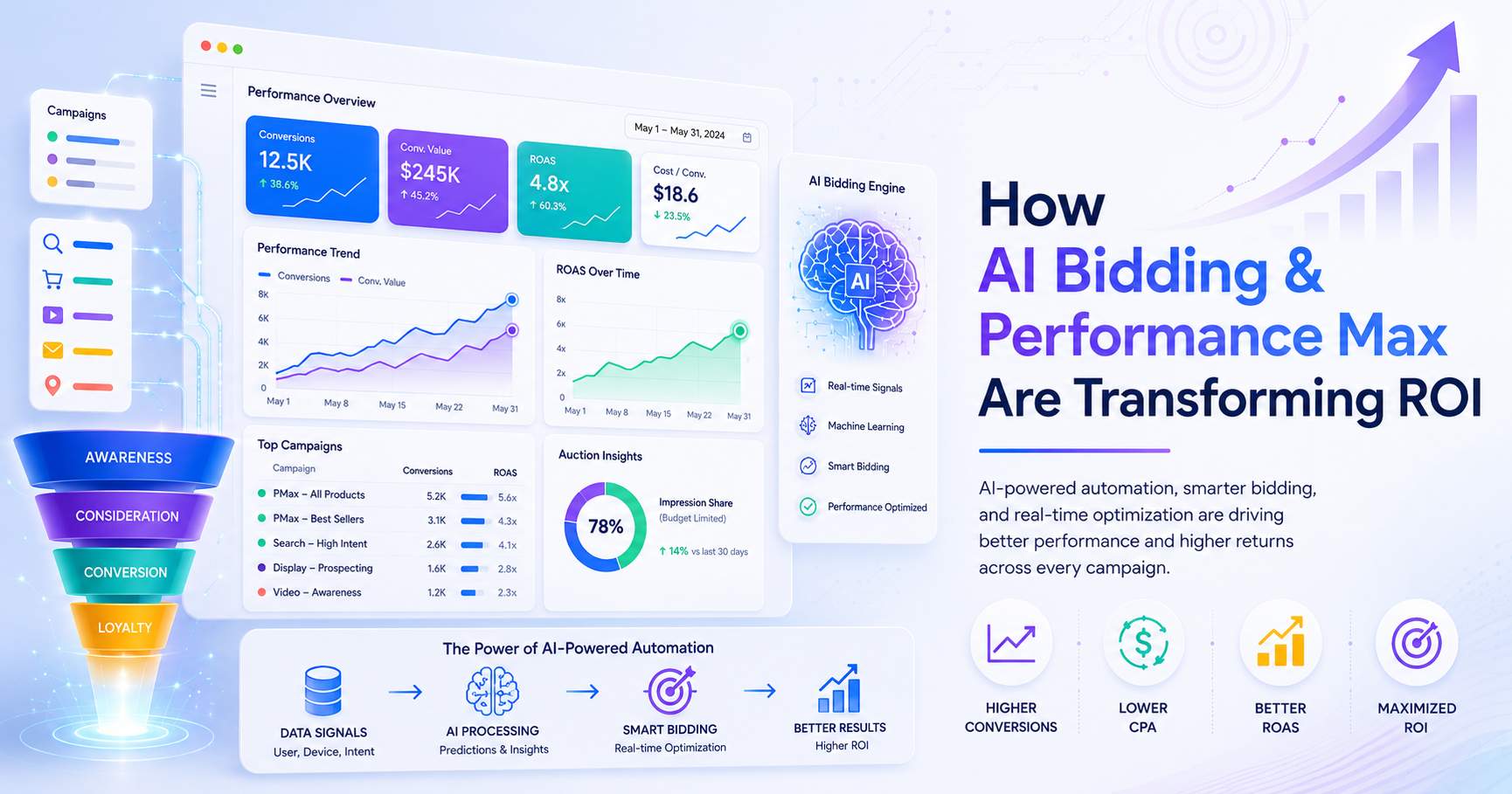
Smart Bidding is Google’s way of automating the bid decision for every single auction using machine learning. Rather than a fixed bid, the system reads live signals at the moment of each search: device, location, time of day, query, browsing behaviour, past conversions, and sets the bid accordingly.
The aim is a specific outcome. That might be hitting a target CPA, maximising return on ad spend, or getting the most conversions from a set budget.
Common AI bidding strategies include:
- Target CPA: bids to get the most conversions at your set cost per acquisition
- Target ROAS: bids to maximise revenue relative to ad spend
- Maximise Conversions: spends the full budget while getting as many conversions as possible
- Maximise Conversion Value: similar, but prioritises higher-value conversions
The practical difference from manual bidding is speed and scale. A human can’t adjust bids for 10,000 auctions a day based on 50 contextual signals. The algorithm does it without blinking.
What Is Performance, Max?
Performance Max (PMax) is a Google Ads campaign type that runs across all of Google’s inventory from a single campaign. Search, Display, YouTube, Gmail, Maps and Discover are all covered under one campaign using AI to decide where and when to show your ads.
You provide the assets: headlines, descriptions, images, videos, and audience signals. Google’s AI takes it from there, testing combinations and shifting budget toward what’s working.
What makes Performance Max different from standard campaigns:
- Single campaign covers all Google channels
- AI controls budget allocation across placements in real time
- Asset groups replace traditional ad groups
- Audience signals guide the algorithm, but don’t restrict it
- Conversion goals drive the entire optimisation
Performance Max is not a set-and-forget tool. It needs clean conversion tracking, strong creative assets and enough conversion data to learn from. Without those, the algorithm has nothing to optimise toward.
How AI Bidding and Performance Max Are Driving ROI Improvement
The ROI improvement businesses are seeing from these tools isn’t accidental. It comes from a few specific advantages that manual campaign management simply can’t match.
1. Real-time bid adjustments at scale
Manual bidding means setting a bid and hoping it holds. AI bidding recalculates for every single auction based on live signals. A user searching at 11 pm on a mobile in a high-intent location gets a different bid than the same query at 9 am on a desktop. That precision cuts wasted spend and pushes the budget toward moments that actually convert.
2. Broader reach without broader waste
Someone who scrolled past your Search ad on Monday might convert after seeing your YouTube ad on Wednesday. Performance Max connects those dots across channels and shifts budget toward the paths that actually close. Separate campaigns can’t do that. The result is better attribution and less wasted spend.
3. Faster learning cycles
Traditional campaign optimisation relies on human review cycles: weekly or bi-weekly check-ins, manual bid adjustments, and A/B testing over months. AI bidding compresses this. The system tests, learns and adjusts continuously. For businesses with consistent conversion volume, the performance curve improves faster than any manual approach.
4. Smarter audience targeting
Performance Max uses your audience signals as a starting point, then expands based on what converts. It picks up patterns humans wouldn’t spot, like users who browsed a specific category three days ago and are now showing different intent signals. This kind of targeting depth is what separates campaigns that scale from ones that plateau.
5. Asset testing without manual effort
In traditional campaigns, creative testing takes time and budget. Performance Max tests headline and image combinations automatically, identifies what’s working and deprioritises what isn’t. Better creative performance feeds better click-through rates, which feeds better Quality Scores, which reduces CPC. The whole system is compound.
What Businesses Need to Get Right
These tools are powerful, but they’re not foolproof. AI bidding and Performance Max only perform as well as the inputs they receive.
Conversion tracking must be accurate. If your tracking setup is missing conversions, attributing them to the wrong source, or counting micro-conversions as primary goals, the algorithm optimises toward the wrong thing. Clean, accurate conversion data is non-negotiable.
Asset quality matters more than quantity. Performance Max needs strong creatives to work with. Weak headlines, generic images and no video will cap performance regardless of budget. Treat asset creation as seriously as targeting.
Give the algorithm time to learn. Smart Bidding and Performance Max both go through a learning period, typically two to four weeks. Changing budgets, targets or assets frequently during this period resets the learning. Patience in the early phase pays off later.
Audience signals need thought. You’re not setting targeting, you’re giving the algorithm direction. Your existing customer lists, high-intent website visitors and similar audiences help the system find the right people faster.
The Role of Expert Management
AI handles the execution. It does not handle the strategy.
Deciding which conversion goals to prioritise, structuring campaigns correctly, building audience signal lists, auditing creative performance, and knowing when the algorithm is misbehaving are still human decisions. Businesses that hand off their campaigns entirely to automation without oversight often see performance degrade over time, usually quietly.
This is where working with a PPC agency in Chennai that genuinely understands how these systems work makes a real difference. The gap between a well-managed Performance Max campaign and a poorly structured one isn’t small. It shows up in CPL, conversion rate and ultimately in what the budget actually returns.
Is AI Bidding Right for Every Business?
Not always. And that’s worth saying plainly.
Smart Bidding needs conversion data to function properly. Below roughly 30 to 50 conversions per month per campaign, the algorithm doesn’t have enough to work with and results get unpredictable. Businesses in that position are better off starting with Maximise Clicks or manual CPC, building up data, then switching to Target CPA or Target ROAS once there’s enough volume for the system to learn from.
Performance Max suits businesses with multiple offerings, decent creative assets and a clear conversion goal. Real estate, e-commerce, education and service businesses with structured lead funnels tend to get the most out of it. If your creative is thin or your conversion tracking is messy, sort those first.
Final Word
AI bidding and Performance Max are not optional extras anymore. They’re the default way Google’s advertising ecosystem operates. Understanding them, structuring campaigns correctly around them, and managing them with proper oversight is what separates businesses that grow their ad ROI from those that just spend more for the same results.
If your current campaigns aren’t structured to take advantage of these tools, the gap between your performance and a competitor who is doing this right will only grow. Partnering with a digital marketing company in Chennai that has hands-on experience with AI-driven campaign management gives you the strategic layer the algorithm can’t provide on its own.