Most small business owners we talk to didn’t start out thinking about SEO or ad spend. They started because they were good at something, baking, fixing AC units, teaching dance, running a clinic, and marketing came later, usually after a slow month made it impossible to ignore. That’s the real problem with going digital: it rarely happens on your own schedule. By the time you decide you need smart marketing strategies, a competitor down the road has often already been running ads for a year. A marketing agency for small business owners can close that gap fast, but even without outside help, the principles aren’t complicated. You just need to know where to put your energy first. If you want to see what a structured approach looks like, a digital marketing agency in Chennai like ours can walk you through it, but the strategy itself works no matter where you’re based.
Why showing up online matters more than it used to
Search a service category in your own city right now, plumbers, dentists, tailors, whatever, and count how many results appear before you reach a business you’ve actually heard of. Usually more than a few. That’s the shift. Customers don’t ask their neighbor for a recommendation first anymore. They search, they compare, and they often decide before they ever speak to a human.
A few things are true for almost every small business right now:
- Customers check reviews before calling, even for trades like plumbing or carpentry.
- A slow website loses visitors in seconds, not minutes.
- Bigger competitors are already spending on ads in your category.
- Word of mouth still matters, but it travels through Google reviews and WhatsApp forwards now, not just conversations.
None of this means you need a huge budget. It means you need to show up where people are already looking, and make it easy for them to act once they find you. We’ve seen a tailoring shop in Velachery double its appointment bookings just by replying to every Google review and keeping its profile photos current, with no ad spend involved at all.
What smart marketing strategies actually look like in practice
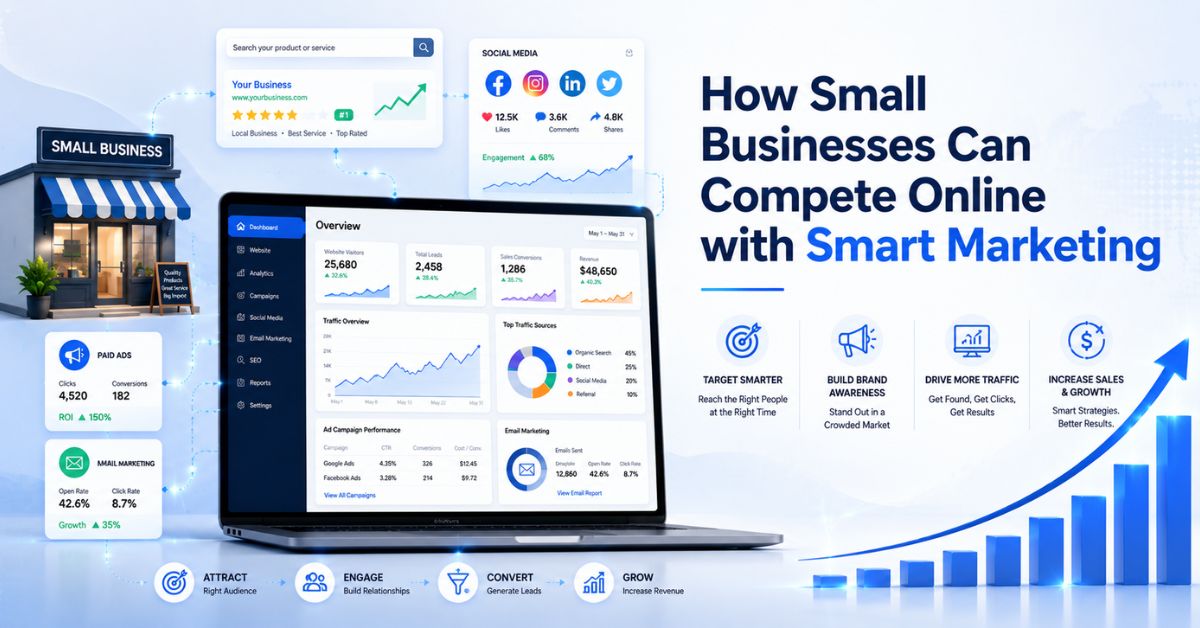
Large companies win on budget. Small businesses can win on speed and personality, since a five-person team can change direction overnight in a way a 500-person company can’t. The point of choosing smart marketing strategies isn’t to copy everything a big brand does. It’s to pick the two or three channels that fit your customers and do those well.
For most small businesses, that shortlist usually includes:
- Search engine optimization, so people searching for what you sell can actually find you
- A Google Business Profile that’s filled out properly, with real photos and updated hours
- Social media is used to show your work rather than just promote it
- Email or WhatsApp follow-ups for past customers, which cost almost nothing and convert well
- Paid ads for quick visibility while the organic side builds up
A bakery in T. Nagar doesn’t need to be everywhere at once. It might post photos of the day’s bakes on Instagram, send a WhatsApp message when a new flavor drops, and let its Google reviews do the rest of the convincing. That’s three channels working together instead of five channels working alone, which is usually the actual difference between marketing that works and marketing that just looks busy.
Building online business growth without burning through your budget
Online business growth rarely comes from one big move. It comes from a website that loads fast, a few dozen genuine reviews, and content that actually answers what your customers are searching for, stacked on top of each other over months.
Some of the groundwork that tends to pay off:
- A mobile-friendly site, since most local searches happen on a phone
- Clear next steps on every page: call this number, book this slot, message us here
- Reviews you actually ask for, not just the ones that show up on their own
- Content that answers real questions customers ask before they buy
- Basic tracking, even just Google Analytics, so you know what’s actually working
Skip the foundation and chase shortcuts instead, and you’ll usually see a short burst of traffic that fades fast. Businesses that treat their online presence as something to maintain, not something to launch once and forget, tend to see steadier online business growth over a year or two rather than a spike that disappears. Most of our clients start noticing this shift somewhere around month three or four, usually as a quiet uptick in calls or form submissions rather than anything dramatic.
When bringing in a marketing agency for small business work actually pays off
You don’t need an agency to start. A lot of small businesses do fine running their own Google Business Profile and posting on Instagram themselves. But there’s usually a point, often somewhere around managing three or four channels at once, where doing it all yourself starts costing more in missed leads than an agency would cost in fees. The pattern we run into most often is a business that tried paid ads alone for a year, bidding on broad keywords that brought in clicks but almost no actual customers, and only realized the budget was being wasted after someone finally audited the account.
What a decent agency partnership tends to add:
- People who already know SEO, ads, and content, instead of you learning all three from scratch
- Tools and data access that would be expensive to buy and maintain on your own
- Faster turnaround, since the workflows already exist
- An outside view that catches gaps you might not notice from inside the business
The honest test of a good agency isn’t how polished their pitch sounds. It’s whether they can explain why they’re recommending something, not just what they’re recommending, and whether their reporting actually tells you something useful instead of just looking busy.
Staying consistent, because that’s the part most people skip
Here’s the part nobody likes hearing: SEO and content marketing take a few months to show real movement, and most businesses give up right around the point when things start to work. Paid ads move faster, but they stop the moment you stop paying for them.
A few habits help here:
- Pick one or two metrics that actually matter, like calls or bookings, and ignore vanity numbers
- Check performance monthly instead of obsessing over daily swings
- Test small changes, a new headline, or a different ad image, before betting big on them
We’ve watched plenty of well-planned campaigns get abandoned after six weeks simply because the owner expected month-one results. The ones that actually stick around long enough to see real traction are usually the ones nobody gave up on too early.
Where to start
Competing online as a small business isn’t really about outspending anyone. It’s about being easier to find, faster to respond to, and more consistent than the business next door. Pick two channels, do them properly for six months, and you’ll likely be ahead of most local competitors who are still trying to do everything at once. If that still feels like too much on top of actually running your business, working with a marketing agency for small businesses can take the day-to-day off your plate without you losing visibility into what’s happening. And if organic search specifically feels like the bigger gap, looking into SEO in Chennai services is usually a reasonable place to begin, even if it’s just a conversation to figure out where you currently stand.