Running a marketing campaign manually (tracking leads, sending emails at the right time, posting on social media, and figuring out what’s actually working) is exhausting. Most businesses hit a ceiling when they try to scale without the right systems in place. There’s only so much a team can do when half their day goes into repetitive tasks that don’t require much thinking. That’s where marketing automation changes things. If you’re partnering with a digital marketing agency in Chennai to grow your brand, knowing how automation works will help you get far more value out of every campaign you run.
What Is Marketing Automation?
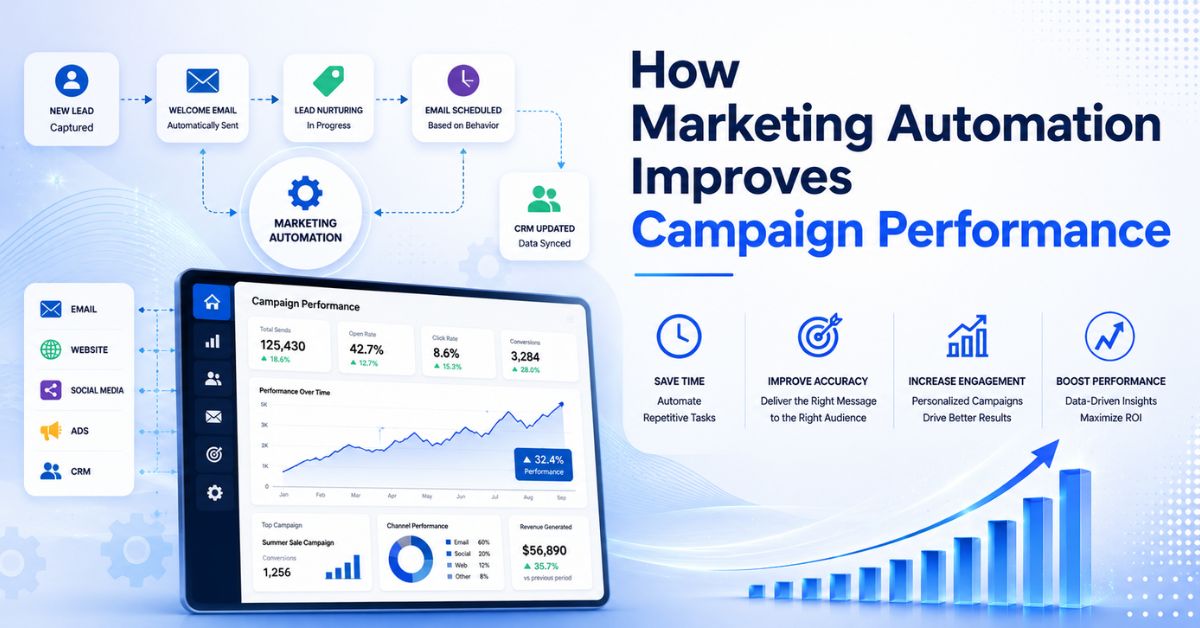
Think of marketing automation as the system running quietly in the background so your team doesn’t have to. It handles the tasks that eat up hours every week (follow-up emails, lead scoring, social scheduling, ad retargeting) without anyone needing to trigger them manually. A prospect fills out a form on your website and gets the right message within minutes, not whenever someone at your office finally gets around to it.
But it’s not just about saving time. When done well, automation sharpens your campaign performance at every stage. Messages land at the right moment, no leads go cold from a delayed follow-up, and your team isn’t buried in execution tasks that could be handled automatically.
The businesses seeing the best results from automation aren’t using it to replace their marketing teams; they’re using it to free those teams up to do better, more meaningful work. That shift in how time gets spent is often where the biggest performance gains come from.
How Marketing Automation Directly Improves Campaign Performance
1. Faster, More Consistent Lead Nurturing
Speed matters enormously in digital marketing. A lead who hears from you within the first hour is far more likely to convert than one you follow up with a day later. That window closes fast, and manually keeping up with dozens or hundreds of new leads every day simply isn’t practical.
Automation handles this without fail:
- A lead fills out a form on your website → an email goes out within minutes
- They open the email but don’t click → a follow-up triggers automatically after 48 hours
- They visit your pricing page → your sales team gets a real-time notification
No delays. No dropped balls. Every lead moves forward on a consistent, well-timed path regardless of how busy the rest of your day gets.
2. Personalisation That Actually Scales
Generic campaigns underperform, and audiences have gotten good at ignoring them. People engage with content that feels relevant to their specific situation. With automation, you can segment your audience by behaviour (pages visited, emails opened, products browsed, geographic location) and deliver messaging tailored to their interests.
A prospect who has been looking at your SEO content gets a completely different email sequence from someone who clicked on a paid ads case study. That relevance shows up directly in your results: stronger open rates, better click-throughs, and more conversions at every stage of the funnel.
3. Real Data Instead of Guesswork
With marketing automation, you stop flying blind. Every click, every email open, every form fill, and page visit is captured and fed directly into your dashboard, without anyone having to pull reports manually.
You can see exactly which subject lines are getting opens, which landing pages are converting, and which audience segments are actually responding, all while the campaign is still running. Most teams are used to doing a post-mortem after things wrap up. Automation gives you the data to fix things while they’re still live.
4. Fewer Errors, Lower Operational Costs
Anyone who has run campaigns manually knows the feeling: an email that went to the wrong list, a discount ad still live a week after the offer ended, a follow-up that never went out because someone forgot. These aren’t catastrophic on their own, but they add up and they leave an impression on your audience.
Automation sets the logic once and runs it consistently every time. For businesses using marketing automation services, that reliability significantly reduces operational overhead without any drop in output quality. Your team does less admin and more of the work that actually moves the needle.
5. Coordinated Multi-Channel Campaigns
Your audience isn’t sitting on a single channel waiting for one type of message. They’re on email, social media, search, and mobile, often within the same hour. Coordinating all of those touchpoints manually across a busy campaign is chaotic and inconsistent.
Automation platforms let you run email, social retargeting, Google Display, and SMS from a single connected workflow. One action from a prospect (clicking an ad, downloading a resource, visiting a product page) can trigger a coordinated response across every relevant channel. That kind of connected experience speeds up the funnel and keeps your brand front of mind throughout the decision-making process.
What to Expect from Good Marketing Automation Services
A tool is only as good as the setup behind it. Quality marketing automation services aren’t just about switching something on; they’re about building workflows that actually match how your customers make decisions. Here’s what that looks like in practice:
- Lead scoring models: Identifying which leads are genuinely sales-ready before your team invests time in them
- Drip campaign sequences: A structured, planned series of messages that moves prospects from first awareness through to a buying decision
- CRM integration: Keeping sales and marketing aligned and working from the same real-time data
- A/B testing workflows: Automatically routing traffic to whichever version of a message, subject line, or landing page performs better
- Re-engagement campaigns: Bringing cold leads back into the funnel before they’re written off entirely
Get these pieces working together, and the impact builds on itself. More qualified leads at the top means better numbers all the way through. That’s the difference between incremental gains and results that actually shift the business.
Common Pitfalls to Avoid
Most automation problems aren’t tool problems; they’re setup problems. Businesses that struggle with automation usually run before they can walk. Here’s what tends to go wrong:
- Automating before you understand your audience: Without clear segments and defined funnel stages, you just end up sending generic messages faster and at greater scale
- Neglecting content quality: Automation handles the timing and the sending; it can’t fix weak copy or irrelevant offers
- Never revisiting workflows: Sequences set up a year ago may no longer reflect your product, your audience, or your goals. Regular audits matter
- Leaving sales out of the loop: Automation that operates independently of your sales team creates disconnected, frustrating experiences for prospects who end up hearing conflicting messages
Final Thoughts
Automation won’t fix a weak strategy, but a solid strategy with good automation behind it runs faster and hits harder than one without. Your team still owns the thinking, the creative direction, and the relationships. The tools just make sure nothing falls through the cracks. That combination is what drives campaign performance that scales.
Pairing automation with a strong organic presence makes both work better. If you’re building this out, take a look at how SEO services in Chennai can drive more of the right traffic into your automated funnels and create a digital presence that keeps growing without constantly having to spend more to maintain it.