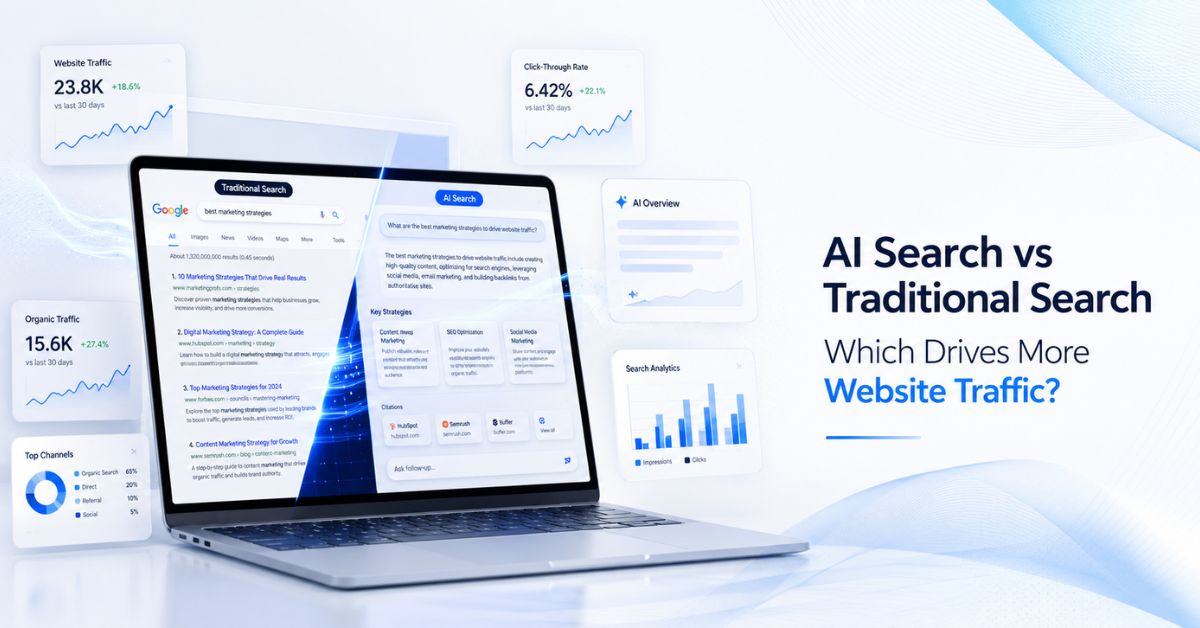
Search is no longer a single-lane road. For two decades, ranking on Google’s first page was the finish line for every digital marketing company in Chennai and their clients. Today, a growing number of queries never reach a results page with ten blue links at all. They end inside an AI-generated summary. This has left business owners asking a fair question: does AI search actually pull more visitors to a website, or is traditional search still doing the heavy lifting? The honest answer is nuanced, and the data tells a more interesting story than the headlines suggest.
The Reality of AI Search Traffic Growth
The momentum is hard to miss. More people are typing questions into ChatGPT, Perplexity, and Google’s AI Mode than they were even a year ago, and AI search traffic growth has gone from a niche talking point to something marketing teams actually budget for.
A few numbers make the shift concrete:
- Search visits through AI tools grew from around 15.6 billion to 27.4 billion in a year. That’s close to 43% growth.
- ChatGPT’s weekly active users went from about 400 million to 800 million in under twelve months.
- Referral traffic sourced from large language models has jumped several hundred percent year over year, according to multiple industry trackers.
- Roughly a third of consumers say they now start their research with an AI assistant rather than a search engine.
What makes this trend worth paying attention to isn’t just the volume. It’s the quality of the visit. Sessions arriving from AI platforms tend to convert better than average organic sessions, mostly because the visitor has already had their basic questions answered and shows up further along in the decision process. Still, the raw numbers remain small next to traditional search. This growth is real, but it’s coming off a much smaller base.
Zero-Click Search Statistics: The Traffic That Never Arrives
If that growth is one half of the story, the other half is arguably more important for anyone running a website. A zero-click search happens when the user gets an answer right on the results page and never clicks through to a site at all.
Recent zero-click search statistics paint a fairly stark picture:
- More than six in ten Google searches in the US now end without a click to an outside website.
- When an AI Overview appears at the top of the page, the zero-click rate for that query climbs even higher, with some studies placing it well above 80%.
- Desktop searches, once considered more click-friendly than mobile, have followed the same downward trend for clicks.
- Out of every thousand searches, only a few hundred now lead to a visit anywhere on the open web. Google’s own properties absorb the rest, or they get answered on the spot.
These zero-click search statistics matter because they change what “ranking well” actually means. A business can hold the number one spot for a keyword and still watch its visitor count drop, simply because the answer is now delivered before anyone needs to click. That’s why marketing teams have started tracking these numbers as closely as rankings themselves. The two reports don’t move together anymore.
Traditional Search Engine Market Share: Still the Center of Gravity
With all this AI disruption in the headlines, it’s tempting to assume traditional search is on its way out. The traffic numbers tell a calmer story.
Traditional search engine market share, led overwhelmingly by Google, still sits close to 90% of global search volume. Even with AI assistants picking up ground, that share has only slipped by a point or two over the past year, nowhere near the collapse some predicted. Bing has gained a little through its Copilot integration, and AI-native tools have picked up small slivers, but the redistribution is happening at the margins, not at the core.
A few reasons this dominance has held up:
- Transactional and navigational queries. Searches like “buy running shoes near me,” “bank login,” or “flight status” are still handled almost entirely by classic search, because people want a destination, not a summary.
- Habit and infrastructure. Google is built into billions of phones, browsers, and workplace tools, an advantage no AI-only product has managed to replicate yet.
- Commercial protection. Google has a strong financial reason to keep the click-through experience alive on high-value, ad-supported queries like e-commerce, even as it summarizes lower-value informational searches directly.
So while AI search traffic growth is the more exciting story to tell, traditional search engine market share is still the bigger number by a wide margin, and it remains the channel most businesses can’t afford to sideline.
Where the Two Actually Collide
The clearest place to watch this play out is right inside Google’s own results page. Our earlier breakdown of AI Overviews traffic impact looked at exactly this: how a single AI-generated summary block can quietly absorb clicks that used to go to the top three organic listings.
A few consistent findings show up across independent studies:
- The organic click-through rate for the top-ranking result drops by roughly 35 to 58% when an AI overview appears above it.
- Pages cited inside the AI Overview tend to hold onto more traffic than pages that rank well but never get cited.
- Informational and “what is” style content suffers the most, while comparison, opinion, and specific commercial content performs better.
- In controlled tests, removing the AI overview from a search page nearly doubled outbound clicks, which is strong evidence that the summary itself, not just changing habits, is pulling traffic away.
In practice, a website can lose organic clicks to Google’s own AI layer even while the search itself never leaves the Google ecosystem, and separately lose a smaller slice of clicks to standalone AI assistants like ChatGPT or Perplexity. Both pressures are real, but they aren’t the same problem, and they don’t call for the same fix.
So, Which One Actually Drives More Traffic?
In simple terms, traditional search still generates significantly more total website traffic today. Google alone dwarfs AI platforms in raw volume, and most commercial and local queries still flow through it. But the picture isn’t standing still.
Here’s the balanced read:
- Traditional search still wins on raw volume today, by a wide margin.
- AI-driven search is growing faster than traditional search, even from a much smaller base.
- The biggest traffic loss isn’t going to AI chatbots directly. It’s going to be AI overviews sitting inside traditional search itself.
- AI-sourced visits tend to convert better, so fewer sessions can still mean similar or stronger business results.
- Traditional search still owns transactional intent, while AI search is winning research, comparison, and exploratory queries.
The takeaway for most businesses isn’t “abandon SEO for AI optimization” or the reverse. Both channels now need to be planned for together, tracked separately, and optimized with slightly different techniques.
What This Means for Your Website Strategy
Given how fast this landscape keeps moving, betting on a single channel is risky. Getting picked up cleanly by AI overviews and AI assistants while still holding onto strong organic rankings takes ongoing work, not a one-time fix. If you’d rather not track every algorithm shift yourself, an experienced SEO services in Chennai team can handle that balancing act for you so your website isn’t caught flat-footed the next time search changes shape.