
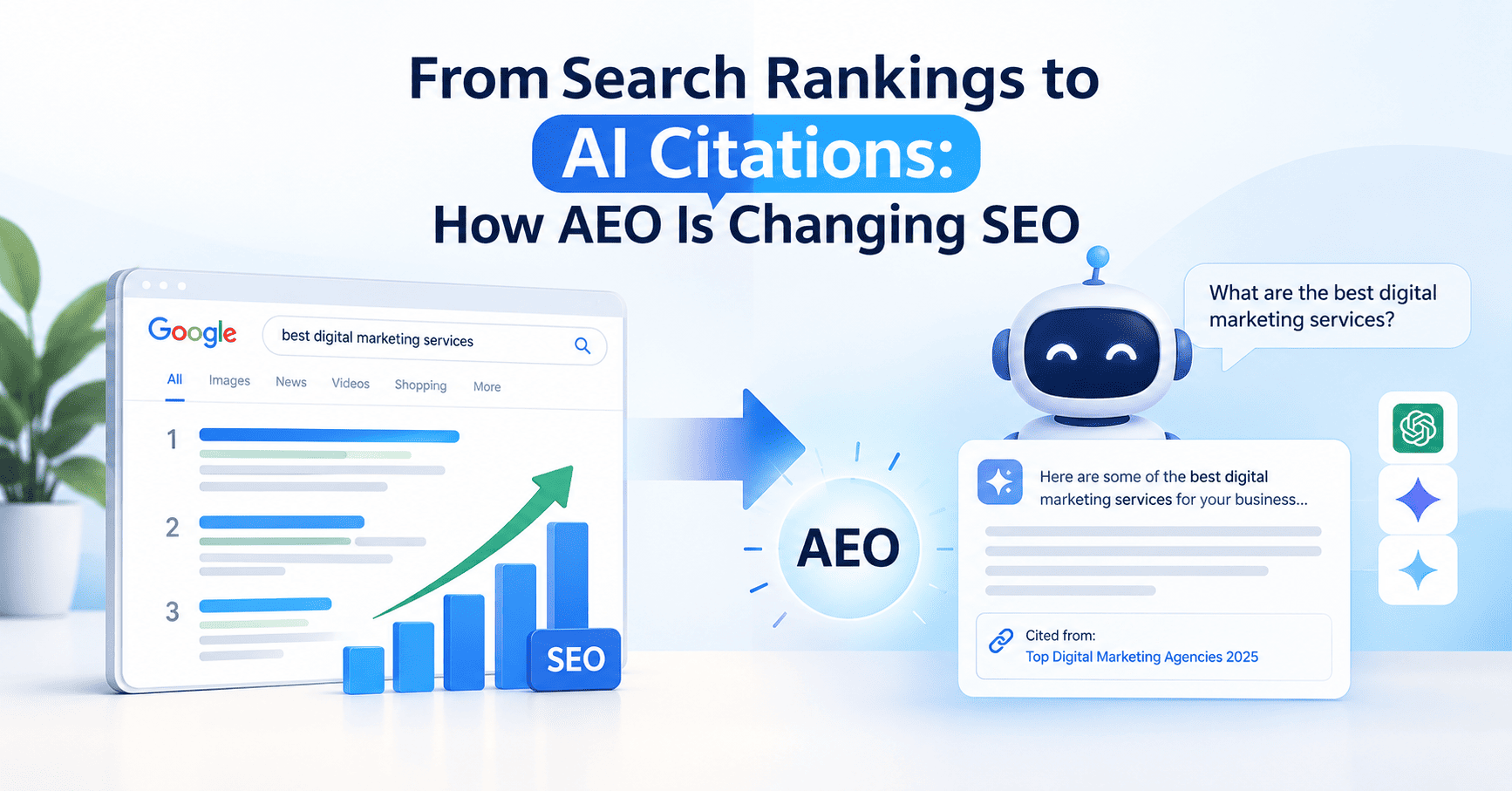
A clinic manager in Adyar opens the monthly report and sees that the page for “dental implants in Chennai” still ranks on the first page. Clicks, however, are lower than they were in spring. At the front desk, a patient mentions that the clinic’s name came up when they asked an AI assistant for options nearby. Neither the report nor the ranking tool records that mention. Answer engine optimization, or AEO, deals with this situation: it prepares content so that AI Overviews, ChatGPT, Perplexity, and similar tools can find it, understand it, and cite it. This article covers what AEO involves, how it relates to SEO, what AI systems appear to check before citing a source, and how a local business can track results. At Infinix360, we now see requests for answer engine optimization services in Chennai arriving alongside standard SEO briefs.
What AEO Means in Practice
AEO is the work of making your content easy for an AI system to quote. Traditional SEO aims for a position in a list of links. AEO aims for a mention inside a written answer.
The pages are often the same. So is much of the research. What changes is how a page is written, and how clearly the business behind it is identified.
Does This Make Traditional SEO Obsolete?
It is a fair question, and the answer is no. AI answers generally draw on pages that search engines have already crawled and indexed. A page with crawl errors, slow loading, or blocked resources may never become a candidate for citation, whatever its wording.
Rankings also still bring visitors, particularly for searches where people want to compare, book, or buy. What has changed is that informational searches now end more often on the results page itself. You still need the ranking. You also need to be the source that the answer names. In our experience, a business that drops SEO work to focus only on AEO often loses the technical base that citations depend on.
What AI Systems Look For Before Citing a Source
The platforms do not publish their selection rules in full, so nobody outside them can promise a citation. Our audits do show a set of signals that appear again and again on pages that get cited:
- A direct answer in the first two or three sentences
- An author name with credentials displayed on the page
- The same business name, address, and phone number across your website, Google Business Profile, and directories
- Organization, LocalBusiness, or Article schema that matches what visitors can read
- References from other sites in your field, such as associations and trade publications
None of these is unusual. Most are missing from the average small-business website, which is why a few weeks of correction can change how a business is described in AI answers.
EEAT ties these signals together. Experience and expertise are easier for a system to confirm when a named person with a checkable history wrote the page. For medical, legal, and financial topics this carries particular weight, because an incorrect answer costs the reader more.
How to Write a Page That Can Be Cited
Take a page about kitchen renovation timelines. The usual version opens with a paragraph about how exciting a new kitchen is. A citable version states the typical range in the first two sentences, then explains what changes it: layout changes, delivery times for materials, and approvals from the apartment association.
Write headings the way customers phrase their questions. Keep each section focused on one point. Where you have first-hand numbers, such as the average duration of your last forty projects, include them with the year they cover. An AI system has no way to produce that detail on its own, and readers value it too.
Length matters less than clarity.
Why Local Details Carry Extra Weight in Chennai
Searches such as “interior designer near Velachery” or “pediatrician in Anna Nagar” tend to produce answers built from Google Business Profile data, reviews, and local listings, along with website content. A business with an incomplete profile may have a strong website and still be left out of those answers.
You can work on this in three steps:
- Choose accurate categories on your Google Business Profile and list every service you offer.
- Ask customers for reviews that mention the service and the area, and reply to each one.
- Publish a separate page for each service and neighbourhood you cover, with details that apply only to that area.
A common problem is a service area listed in one place and missing in another, such as OMR on the profile but absent from the website. Review replies are easy to skip. They are also read by both customers and AI systems.
Tracking Citations Without Perfect Data
You may be wondering how to measure something that no dashboard reports cleanly. That limitation is real. Most analytics tools do not yet show citations directly, so you will need a manual method alongside them.
Choose fifteen to twenty questions your customers ask. Once a month, enter them into Google, ChatGPT, and Perplexity. Record whether your business is named, which page is cited, and whether the description is accurate. In Google Analytics, check referral traffic from AI platforms. In Search Console, watch impressions on question-style queries.
Results will vary from one month to the next, because AI answers are not fixed. Compare quarters, not weeks. Dated screenshots help when you report the results to a manager or client.
What to Do With the Ranking Report
Go back to the clinic manager from the start. The ranking report was accurate. It was also incomplete, because it did not show where the clinic was being named, or where it was missing.
Adding a monthly log of AI answers would give the manager that view. From there, the work is specific: correct the listings that show an old phone number, rewrite the three most visited service pages so the answer comes first, and add author biographies with credentials. After a few months, the log shows whether the clinic is being named, and for which questions.
When you compare SEO companies in Chennai, ask which AI platforms they check, how they record citations, and how they handle technical basics such as indexing and schema.