Most businesses reach for traffic first. More ads, more blog posts, more keywords. It feels like progress because the visitor numbers go up. Revenue often stays exactly where it was.
If you are comparing Digital Marketing services in Chennai, settle one question before you spend anything: what happens after a visitor lands on your site? A conversion strategy answers it. It decides what you want visitors to do, how your pages help them do it, and how you measure the result. We build that plan first, so the traffic you pay for has somewhere useful to go.
What Is a Conversion Strategy?
A conversion strategy is a plan for turning visitors into customers. A conversion is any action that moves someone closer to buying from you. It could be a phone call, a form submission, a WhatsApp message, a quote request or a purchase.
The strategy picks the actions that matter most to your business. It then shapes your pages, offers and follow-up around them. Without it, a website is a collection of pages. With it, every page has a job.
Why More Traffic Alone Does Not Raise Revenue
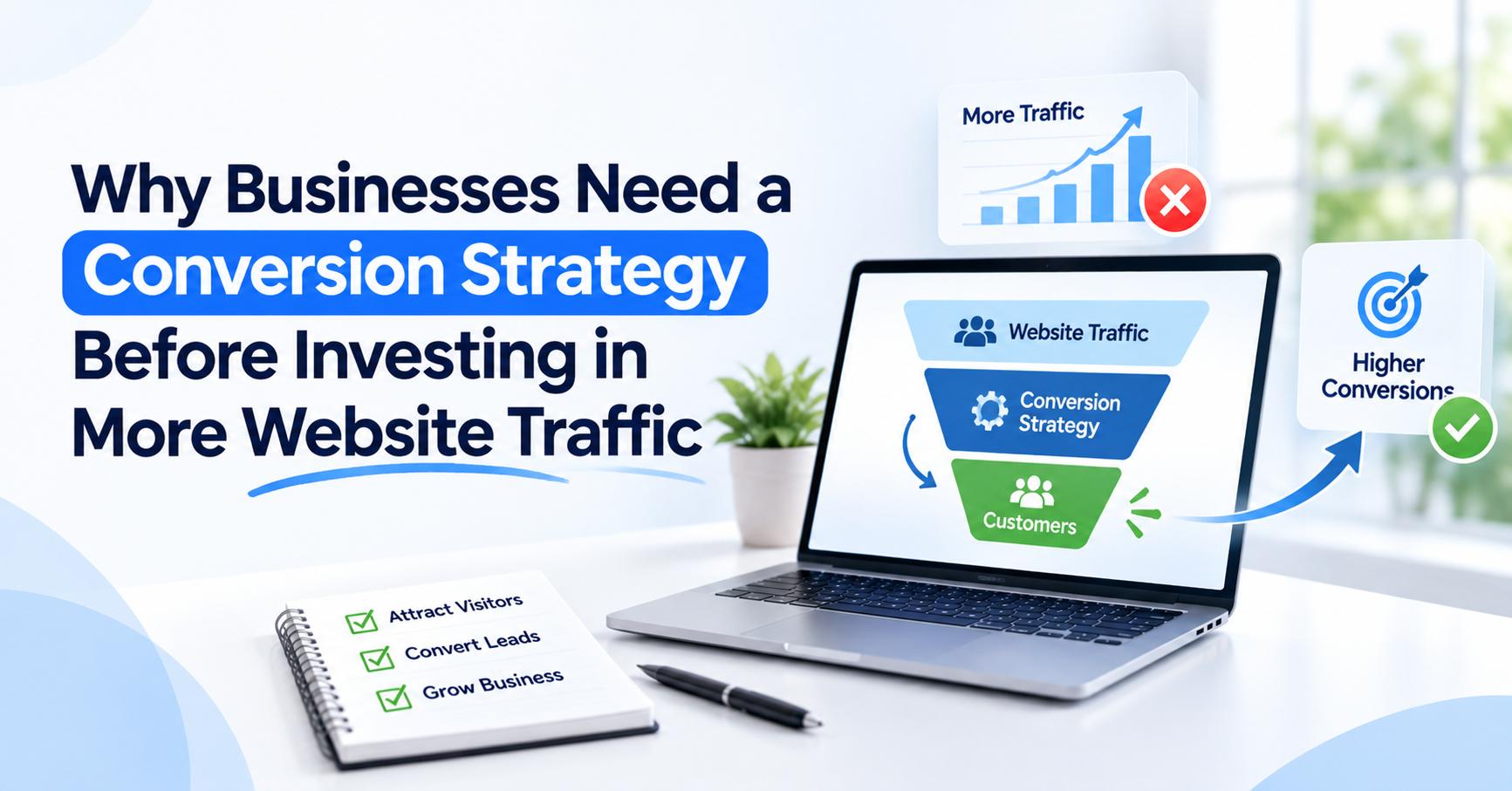
Traffic only counts when visitors act. Say your site gets 5,000 visitors a month and 1 percent of them enquire. That gives you 50 enquiries. To reach 100, you could double your traffic, which also doubles your ad or SEO spend. You could also lift your conversion rate to 2 percent and reach 100 enquiries with the visitors you already have.
| Scenario | Monthly Visitors | Conversion Rate | Enquiries |
|---|---|---|---|
| Current | 5,000 | 1% | 50 |
| More Traffic Only | 10,000 | 1% | 100 |
| Better Conversion Only | 5,000 | 2% | 100 |
| Both | 10,000 | 2% | 200 |
Your cost per enquiry stays the same in the second row and drops in the last two. The same budget produces more results because fewer visitors leave without acting.
Signs Your Website Has a Conversion Problem
Your analytics can tell you where visitors are getting stuck. Look for these patterns:
- Visitors leave your landing pages within a few seconds.
- Traffic grows month after month, but enquiries stay flat.
- People start your contact form and do not finish it.
- Mobile visitors rarely call or submit a form.
- The enquiries you receive are mostly from people who cannot afford or do not need your service.
Any one of these points to a gap between what visitors expect and what your page delivers. More traffic will only widen that gap.
What a Conversion Strategy Includes
A conversion strategy follows a visitor from the first click to the enquiry. For every client, we work through these seven areas.
- Audience research: Who is buying, what they type into Google, and what makes them hesitate before getting in touch.
- A clear offer: What you sell, who it suits, and why someone should act now.
- Page structure: Headings and layout follow the questions a visitor asks, in the order they ask them.
- Calls to action: Buttons that say what happens next, placed where a visitor is ready to take that step.
- Forms and contact options: Short forms, click-to-call buttons, and WhatsApp links, all tested on a phone.
- Proof: Reviews, case studies, certifications, and project photos. A first-time visitor has no other reason to trust you yet.
- Tracking: Goals and events in your analytics, so each enquiry traces back to where it came from.
How Conversion Strategy and Traffic Work Together
Conversion work does not replace traffic. It decides where traffic should go and when to increase it. The order we follow looks like this:
- Fix the basics. Speed up slow pages, repair broken forms and make sure your site works well on mobile.
- Clarify your key pages. Rewrite service and landing pages so each one speaks to one audience and one action.
- Test changes. Compare headlines, buttons and form lengths, and keep the version that produces more enquiries.
- Send more traffic to pages that convert. Once a page performs well, we put more SEO and ad budget behind it.
- Review every month. Traffic sources, page performance and enquiry quality are checked against your goals.
This order protects your budget. You scale what works instead of paying to find out what does not.
How We Build Your Conversion Strategy
We start with an audit of your current site, your analytics and your enquiry data. This shows us which pages bring visitors in, which ones lose them and what your best customers have in common.
Next, we agree on the actions that count as a win for your business. A manufacturer may want quote requests. A clinic may want booked appointments. A real estate company may want site visit enquiries. We set up tracking for each one before we change anything on the site.
Then we make the changes in priority order. We rework page copy, tighten forms, add proof and improve mobile layouts. After that, we plan your SEO, paid ads and content around the pages that are ready to convert. You receive a monthly report in plain language that shows enquiries, cost per enquiry and what we plan to test next.
Numbers to Track Once Your Strategy Is Live
A few numbers tell you whether your strategy is working. We report on these every month:
- Conversion rate: the share of visitors who complete your main action.
- Cost per enquiry: your marketing spend divided by the enquiries it produced.
- Lead quality: how many enquiries turn into sales conversations or orders.
- Landing page exit rate: where visitors leave without acting.
- Mobile versus desktop conversions: whether both device types perform as they should.
Watching these together keeps you from judging results by visitor count alone.
Build the Path First, Then Add the Traffic
Traffic is the cost of getting people to your door. Conversion is what happens once they step inside. When you plan the second part first, every rupee you spend on the first part works harder.
We can audit your website, set up tracking and map the actions that matter to your business. If your plans also include product demos or explainer content, we can work alongside a video production company in Chennai to place those videos on pages built to turn viewers into enquiries. Get in touch with us, and we will show you where your website is losing visitors and what it would take to keep them.