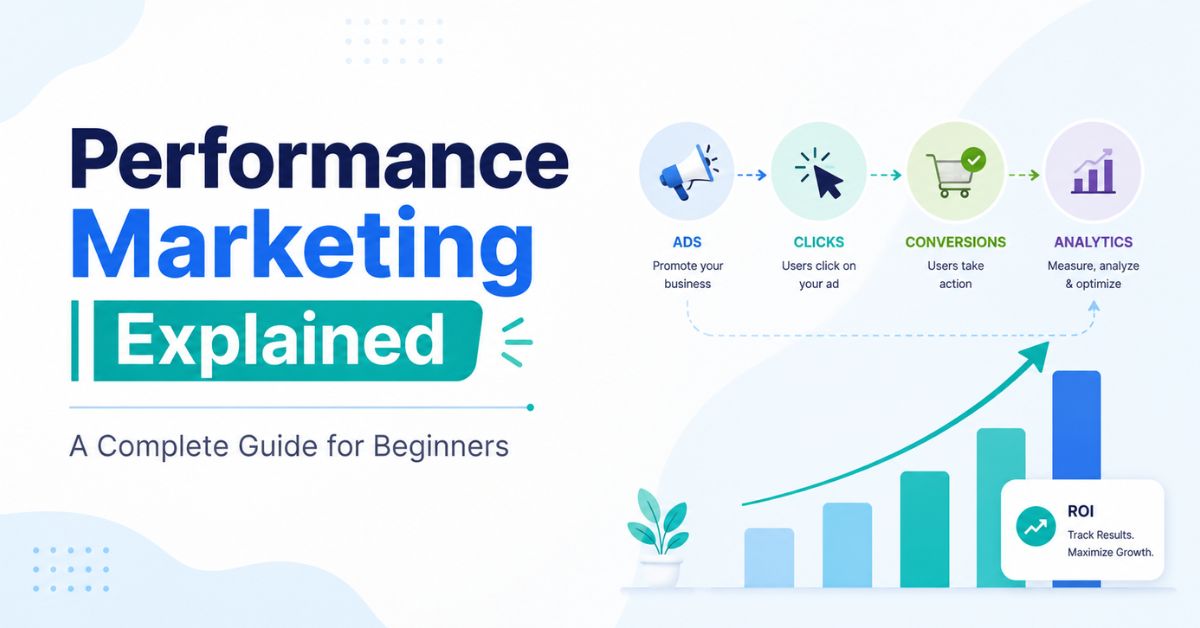
Most advertising works on faith. You spend the budget, run the campaign, and hope the results follow. Performance marketing flips that model on its head. Every rupee you put in is tied to a measurable outcome: a click, a lead, a sale. You only pay when something actually happens. For businesses that want ROI-driven marketing built into their spend from the start, it’s one of the most practical approaches available today.
If you’re new to this and wondering how it works, who it’s for, and what to watch out for, this guide covers all of it.
What Is Performance Marketing?
Traditional advertising asks you to spend first and hope for the best. Performance marketing works the other way. Your budget moves only when a real outcome is delivered. A click, a lead, a sale. Something you can point to.
The pricing model reflects that:
- Cost Per Click (CPC): You pay when someone clicks
- Cost Per Lead (CPL): You pay when someone fills a form
- Cost Per Acquisition (CPA): You pay when a sale or sign-up is completed
- Cost Per Install (CPI): Common in app marketing, paid per download
- Revenue Share: You pay a percentage of the revenue generated
Every rupee is accounted for. That’s what makes it different.
How Does Performance Marketing Work?
Your business (the advertiser) sets a goal, whether that’s a purchase, a sign-up, or a call booking, then works with a platform, publisher, or affiliate to reach the right audience. Payment only kicks in once that goal is met.
The channels it runs across:
- Paid Search (PPC): Your ad shows up when someone searches for what you offer on Google or Bing
- Paid Social: Targeted ads on Meta, LinkedIn, or Instagram built around who your buyer actually is
- Affiliate Marketing: Publishers drive traffic to your offer and earn a commission per conversion
- Programmatic Advertising: Automated buying that gets your ad in front of the right person across the web
- Influencer Partnerships: Collaborations where the payout is tied to tracked outcomes, not just exposure
No single channel fits every business. Your audience, product, and funnel stage all factor into which ones make sense for you.
Why Businesses Are Moving Toward Performance Marketing
Budgets are tighter, scrutiny is higher, and “we think it’s working” isn’t good enough anymore. Performance marketing suits the way modern businesses actually want to spend.
You see exactly where the money goes. Every click, lead, and conversion is tracked. You’re not guessing which part of the campaign worked. The data tells you.
Wasted spend is limited by design. When payment is tied to action, you’re not funding people who scroll past your ad. The model has a built-in natural filter.
Scaling is straightforward once something works. A campaign that converts at a small budget can be turned up. You’re not experimenting. You’re doubling down on proof.
Targeting is specific. Location, device, age, search intent, browsing behaviour: performance platforms let you get precise about who sees your ads and when.
The data compounds. Each campaign teaches you something. Over time, that learning makes your targeting sharper, your creative better, and your spending more efficient.
Performance Marketing vs Brand Marketing
People tend to pit these against each other. They shouldn’t.
Brand marketing does the slow work: building recognition, trust, and recall over time. It’s harder to measure, but it quietly makes your performance campaigns more effective. A prospect who already knows your name is more likely to click your ad than one who’s never heard of you.
Performance marketing is where that groundwork pays off. It converts existing interest into action, turning brand awareness into leads and sales.
Businesses that use both tend to outperform those that pick one. Brand builds the audience; performance harvests it.
Key Metrics to Track in Performance Marketing
Numbers tell you whether a campaign is working or just running. These are the ones worth watching:
- Return on Ad Spend (ROAS): How much revenue comes back for every rupee spent. If this number is healthy, the campaign is doing its job.
- Conversion Rate: Of all the people who saw or clicked your ad, what percentage followed through? This is the clearest signal of whether your message and landing page are doing their job.
- Customer Acquisition Cost (CAC): Total campaign spend divided by the number of new customers acquired. The number only means something when you weigh it against what those customers are actually worth.
- Click-Through Rate (CTR): A low CTR usually means your creative isn’t landing or your targeting is off.
- Lifetime Value (LTV): What a customer spends with you over their entire relationship with the brand. This is what makes CAC make sense, or reveal that something needs fixing.
Look at these together, not in isolation. A high CTR with a poor conversion rate points to a landing page problem. A good conversion rate with a high CAC might mean your targeting needs tightening.
Common Mistakes Beginners Make
Performance marketing looks straightforward from the outside. In practice, there are a few pitfalls that catch most beginners out.
Optimising for the wrong metric. Chasing clicks when you should be chasing conversions is one of the most common errors. High traffic means nothing if none of it converts.
Ignoring landing page quality. Your ad gets people to the page. Your landing page is what gets them to act. A great ad paired with a weak landing page is money wasted.
Setting and forgetting campaigns. Performance campaigns need regular attention. Bids, audiences, and creatives all need to be reviewed and adjusted as data comes in.
Not giving campaigns enough time. Pulling the plug too early, before an algorithm has enough data to optimise, is a mistake many newcomers make. Most platforms need a learning period before results stabilise.
Skipping audience segmentation. Sending everyone to the same ad with the same message rarely works. Different audiences have different motivations. Your campaigns should reflect that.
How to Choose the Right Performance Marketing Partner
Running performance campaigns in-house is doable, but the platforms are complex, the learning curve is real, and mistakes cost money. Most businesses get better results faster by working with people who already know the terrain.
Good performance marketing companies bring tested frameworks, not guesswork. They know which levers to pull, how to read the data, and how to adjust when something isn’t performing. Look for transparent reporting and clear attribution. If an agency can’t show you exactly where your results came from, that’s a problem.
The best performance marketing companies don’t just manage campaigns. They understand the full path from first impression to closed sale, and they’re constantly looking at what’s holding that path back.
When comparing top performance marketing agencies, dig into how they handle campaigns that aren’t working. Any agency can manage a campaign that’s performing well. What separates good ones is how quickly they diagnose problems and what they do about them.
The top performance marketing agencies also take the time to understand your actual business goals before touching a campaign. Impressions and reach are easy wins on paper. Revenue and pipeline growth are what actually matter.
Getting Started
Performance marketing doesn’t require a massive budget to begin with. Start with one channel, define your target action clearly, set a realistic test budget, and measure everything. The data from your first campaigns will tell you more than any strategy document.
Paid campaigns generate results now. But if you want visibility that compounds over time, pairing your performance efforts with an SEO company in Chennai means you’re building an asset, not just running a tap.
For a fully joined-up approach covering paid, organic, content, and conversion, a digital marketing company in Chennai with experience across all channels is worth talking to. The businesses that scale fastest are the ones where every channel is pulling in the same direction.