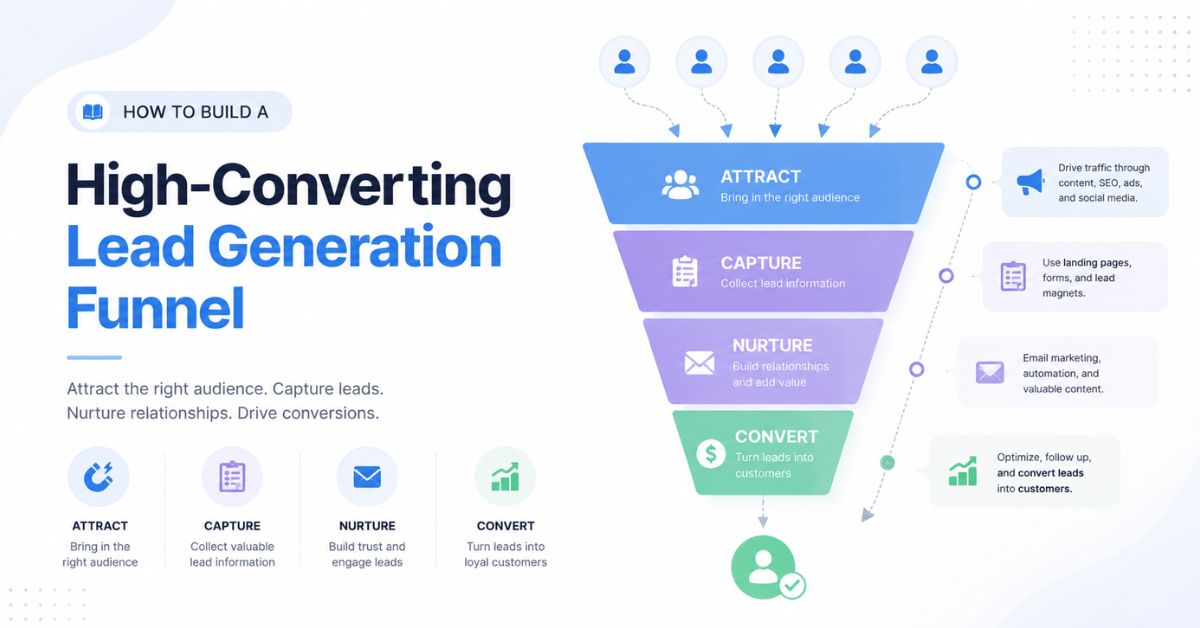
Getting traffic to your website is one thing. Turning that traffic into paying customers is an entirely different challenge, and that’s exactly where most businesses lose the plot. A well-structured lead generation funnel bridges that gap. It takes a stranger who barely knows your brand and walks them, step by step, toward becoming a qualified lead your sales team can actually close.
Brands that grow predictably don’t just get lucky with referrals. They have a solid lead generation strategy doing the heavy lifting: pulling in the right people, warming them up, and handing the sales team a contact who’s already halfway convinced. This post breaks down how to build that system from scratch.
What Is a Lead Generation Funnel?
Picture it as a path your buyer walks. They find you, start paying attention, and at some point decide they want what you’re selling. That entire journey is your lead generation funnel, and it typically plays out across three stages:
- Top of the funnel (TOFU): Brand new eyeballs. They know you exist and not much else.
- Middle of the funnel (MOFU): They’re genuinely curious and comparing their options.
- Bottom of the funnel (BOFU): Ready to act. They just need the right reason to choose you.
What you say to someone at stage one should look nothing like what you say to someone at stage three. Match the message to the moment.
Step 1: Define Your Ideal Customer Profile
Before you build anything, get clear on who you’re building it for. A lead generation funnel that speaks to everyone converts no one.
Ask yourself:
- What industry or demographic is my buyer in?
- What problems are they actively trying to solve?
- What objections do they typically raise before buying?
- Where do they spend time online?
The more specific your answers, the sharper your funnel will be. This isn’t just a theoretical exercise. Your ICP directly shapes your ad targeting, landing page copy, and follow-up sequence.
Step 2: Drive Traffic to the Top of the Funnel
No visitors, no leads. Simple. Your lead generation strategy has to start with getting the right people to your pages, and you’ve got two ways to do it.
Organic traffic through SEO, content, and social media is slow to build but pays off for years. One well-ranked blog post or video can quietly send qualified visitors your way long after you’ve published it.
Paid traffic is the shortcut, and a smart one when used correctly. PPC leads are what you get when someone clicks your Google or Meta ad and lands on a page designed to capture them. These are high-intent prospects who were already searching for a solution. The beauty of PPC is control: you decide who sees the ad, when, on what device, and at what budget.
Most businesses do best with both running in parallel. SEO builds your long-term presence; PPC keeps leads coming in while it does.
Step 3: Build a High-Converting Landing Page
Here’s where most businesses throw money away. They run ads, drive traffic, and then dump visitors on a homepage with ten different things competing for attention. Unsurprisingly, nobody converts.
Your landing page has one job: get the lead. Everything on it should serve that goal, and anything that doesn’t should be cut.
Key elements of a high-converting landing page:
- A headline that hits a nerve: call out the problem your visitor is already losing sleep over
- A value proposition that answers “so what”: be specific about the outcome, not just the offering
- Social proof: Testimonials, case studies, logos of clients you’ve worked with
- A single, friction-free CTA: One form, one button, no distractions
- Mobile optimisation: Over 60% of web traffic is mobile; if your page doesn’t load cleanly on a phone, you’re losing leads before they even read the headline
No navigation bar pulling people away. No secondary offers muddying the message. Just a clean page that does one thing well.
Step 4: Offer Something Worth Exchanging Contact Details For
Asking someone for their email before they trust you is a hard sell. A good lead magnet flips that. It gives them something valuable upfront, so handing over their details feels like a fair trade.
What tends to work well:
- A free audit or consultation (especially effective for service businesses)
- A downloadable guide, checklist, or template built around a real problem they face
- A case study showing what you’ve achieved for clients in their space
- A free trial or demo if you’re selling software or a product
- A short training or webinar that tackles something they’re actively trying to figure out
Ask yourself: if this weren’t free, would anyone buy it? If you’re not sure, sharpen it. A forgettable freebie doesn’t just fail to convert. It sets a low bar for everything that follows.
Step 5: Nurture Leads with a Follow-Up Sequence
Getting someone to opt in is step one. What happens next is where most businesses drop the ball.
The average prospect isn’t ready to buy on day one. They filled out your form because something caught their attention, not because they’re ready to sign. Your follow-up sequence is what bridges that gap. A good email nurture flow does several things over the days after someone opts in:
- Delivers on the promise of your lead magnet immediately
- Introduces your brand story and builds credibility
- Tackles the objections your prospects raise before they even voice them
- Shares proof through client outcomes and real results
- Guides them toward the next step: a call, a demo, or a purchase
Aim for 5–7 emails over 10–14 days. Not every email should sell. In fact, most shouldn’t. Educate first, and the selling becomes much easier.
Step 6: Use Retargeting to Re-engage Cold Leads
Not every visitor converts on the first visit. That’s normal. Retargeting lets you stay in front of people who showed interest but didn’t take action, and it’s one of the highest-ROI activities in digital advertising.
PPC leads generated through retargeting campaigns tend to convert at significantly higher rates than cold traffic because you’re reaching people who already know who you are. A prospect who visited your pricing page and left without converting is a very different person from someone seeing your ad for the first time.
Use retargeting ads to:
- Remind them of your offer
- Share a customer success story
- Present a limited-time incentive to nudge them over the line
Step 7: Track, Test, and Optimise
No funnel is finished on launch day. The ones that actually perform well are the ones that get looked at, questioned, and improved consistently.
At a minimum, keep an eye on:
- Cost per lead (CPL): Are you acquiring leads at a sustainable cost?
- Lead-to-close rate: Of everyone who opted in, how many actually bought?
- Landing page conversion rate: What share of visitors are filling out the form?
- Email open and click rates: Are your follow-ups getting ignored or clicked?
- ROI by channel: Where are your best leads actually coming from?
Test things. Your headline, the CTA button copy, how many fields are on your form, your ad visuals: all of it is worth experimenting with. A single change to a landing page headline has been known to shift conversion rates by double digits. You won’t know until you try.
Putting It All Together
No single tactic builds a high-converting lead generation funnel. It’s always a combination of things working in sync: the right traffic, a landing page that earns trust, an offer worth opting into, and follow-ups that actually move people forward. Get those four working together, and you’ve got a pipeline that runs without you chasing every lead manually.
For businesses that want faster results on the paid side, a PPC agency in Chennai with hands-on experience in lead gen campaigns can cut the learning curve significantly and put quality leads in front of your team sooner.
If the goal is building something more sustainable across all channels, a Digital Marketing Company in Chennai that handles SEO, paid ads, and content together gives you a much stronger foundation to grow from.
Your next customer is searching right now. Make sure your funnel is the one that catches them.