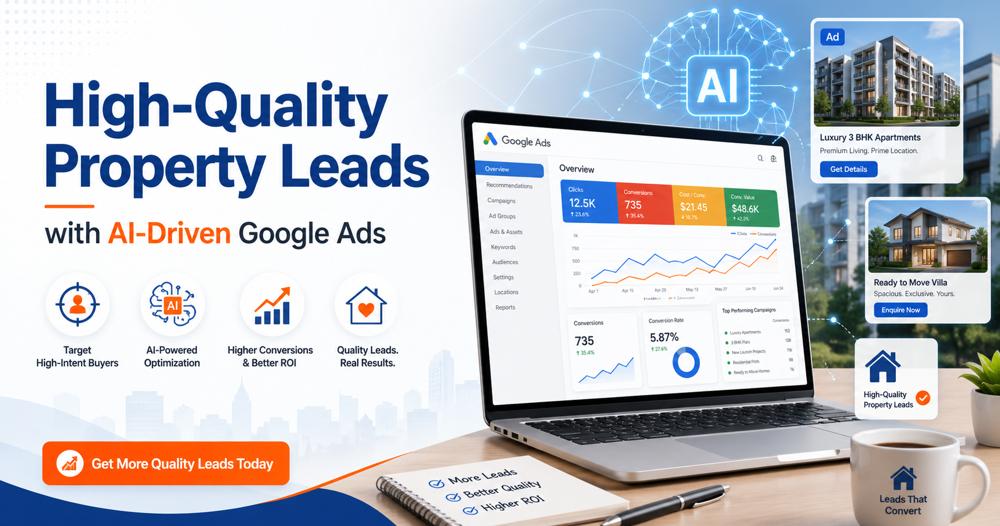
Real estate marketing has evolved from a competition of billboards to a data-driven strategy. Most developers and agencies in the current market waste significant portions of their budget on cold calling lists that are either outdated or overused. This is why partnering with a reliable ppc company in Chennai is often the foundational step in building a digital moat that protects your brand’s reach. If you intend to scale property sales in a crowded market, you must master the nuances of google ads for real estate leads because the search intent for property is higher than almost any other consumer sector. People searching for “3BHK near me” are not just browsing: they are signalling a major life transition.
The fundamental problem with traditional digital advertising was its rigidity. You chose a keyword, set a bid, and hoped for the best. Today, the landscape is dictated by machine learning models that process signals human traders simply cannot see. This shift toward AI property lead generation has moved past simple keyword matching into the territory of predictive audience modeling. Google’s algorithms now evaluate thousands of variables, such as past search history, location frequency, and cross-device behavior, to determine if a user is a serious buyer or just a digital window shopper.
Identifying Intent Beyond the Search Query
A lot of real estate lead generation companies prioritize lead volume over actual purchasing power. Getting a spreadsheet with a thousand names doesn’t help if most of those people lack the capital for a serious down payment. AI models address this by monitoring behaviors that signal a genuine move, such as high-frequency visits to tax valuation sites or local school performance reports.
By leveraging google ads for real estate leads, you are bidding on these high-intent behaviors. It allows you to intercept the serious investor who has just liquidated an asset and is looking for a tax-saving property investment. Unlike social media platforms where you are interrupting a casual scroll, search ads place your project in front of someone who has already made the decision to look. This difference in mindset is the reason search-driven leads consistently show a higher conversion rate, provided the campaign isn’t being drained by broad, low-intent keywords that waste the daily budget.
Strategic Use of Visual Assets
Static images on a landing page are no longer enough to move the needle in a luxury market. You need to follow the prospect with a cohesive visual narrative that reinforces the project’s value. Using google display ads for lead generation allows you to place high-resolution renders and walkthrough videos on the specific news and finance sites your target demographic visits daily. This is not about generic brand awareness: it is about maintaining presence during the long decision-making cycle.
- High-Intent Retargeting: Show your floor plans specifically to users who have already downloaded your brochure but haven’t booked a site visit.
- Contextual Placement: Ensure your luxury penthouse banners appear on premium lifestyle portals rather than generic mobile apps.
- Frequency Capping: Use AI to ensure you are not annoying the prospect by showing the same ad too many times, which preserves brand reputation.
When you use google display ads for lead generation correctly, you are building a mental association between your brand and the specific lifestyle the buyer desires. The machine learning models tackle the challenge of identifying the specific ad format or visual style that drives the highest engagement among high-net-worth individuals. This allows your team to focus on the creative strategy while the AI optimizes delivery to maximize lead quality.
The Technical Advantage of AI Property Lead Generation
The most significant change in Google Ads recently is the move toward Performance Max and Smart Bidding. These systems take the control out of the hands of the manual optimizer and give it to the AI. While this can be scary for traditional marketers, the results are usually superior if the input data is clean. AI property lead generation relies on “Conversion Value” rather than just “Conversion.” By telling the AI which leads are more valuable (for example, those who booked a site visit versus those who just downloaded a brochure), you train the system to find more people like your best customers.
This level of optimization requires a deep understanding of the backend. It isn’t enough to just set up an ad: you need to ensure your tracking pixels and offline conversion imports are functioning perfectly. Many real estate lead generation companies fail because they treat the AI as a “set and forget” tool. In reality, the AI is only as good as the data it receives. If you feed it junk leads from a poorly designed landing page, it will diligently go out and find you more junk.
Key Factors for High-Converting Ad Sets
- Hyper-Local Targeting: Do not just target a city. Target specific neighborhoods and even high-value corporate parks where your ideal buyers work.
- Dynamic Search Ads: Let the AI generate headlines based on the actual content of your project website to ensure a perfect match with the user’s query.
- Negative Keyword Scrubbing: This is where the human element is still vital. You must aggressively avoid terms like “cheap,” “rent,” or “low cost” when selling luxury apartments.
- Ad Extensions: Use location, call, and lead form extensions to reduce friction between seeing the ad and making an inquiry.
The complexity of these systems is why many developers are moving away from in-house management. They realize that a specialized team can achieve a much lower cost-per-acquisition. The data show that campaigns using advanced AI property lead generation techniques achieve a 30% increase in lead quality compared to standard manual bidding.
Why Quality Leads Cost More and Why That is Okay
There is a common trap in real estate marketing: the obsession with the lowest Cost Per Lead (CPL). If you tell your marketing team to lower the CPL, they will likely switch to broader, lower-intent keywords. You will get more leads, but your sales team will spend all day talking to people who can’t afford the property or just want information.
Focusing on high-quality leads means accepting a higher CPL in exchange for a higher lead-to-close ratio. When you use Google’s machine learning, you are essentially paying a premium for the algorithm’s “certainty” that a user is a high-value prospect. This is a strategic investment. Every hour your sales team spends on a “junk” lead is an hour they aren’t spending with a serious buyer.
Converting Paid Insights into Permanent Organic Assets
Relying solely on paid search is a high-risk strategy because you are essentially renting visibility. The data generated by your PPC campaigns should dictate exactly which organic assets you build next. If a specific long-tail search term is consistently driving high-intent traffic to your ads, that is your signal to stop paying for that click and start earning it. Developing a dedicated page for that specific topic creates a permanent lead source that doesn’t disappear when the daily budget resets. This shift from renting space to owning the search result is the only way to build sustainable brand equity in a competitive market.
Scaling a Funnel through Technical Precision
Building a lead funnel that actually scales isn’t about finding a magic setting in the Google dashboard. It requires a relentless focus on lead tracking and the patience to let the machine learning models gather enough conversion data to be effective. Most real estate firms quit too early. They see a high CPL in week one and panic, but the reality is that the AI needs a baseline of successful conversions to understand who the actual buyers are. If your lead tracking is broken or your landing pages are slow, the entire campaign is a waste. High-quality property leads are readily available, but you need a backend that supports AI. Investing in expert Digital Marketing services in Chennai ensures that your brand is positioned to capture buyers at the exact moment they are ready to transact, rather than just browsing.