Most brands still treat targeting as the most important factor in paid social, but the platforms have quietly shifted the focus elsewhere. Meta, Instagram, and TikTok now reward the creative itself: the hook, the pacing, and the way it looks the moment it lands on someone’s screen. A well-targeted campaign built around a weak visual still underperforms, while a scroll-stopping ad can outrun a mediocre audience setup. This is why so many businesses working with digital marketing services in Chennai are shifting their budgets and attention toward the ad itself, not just who sees it. If you’re trying to build a high-converting ad creative for your next campaign, the fundamentals below will save you a lot of trial and error.
Why Creative Has Become the Real Growth Lever
A few years ago, audience targeting and bidding strategy did most of the work. That’s changed. Meta’s own delivery system now leans heavily on early creative signals like hook rate and watch time to decide which ads get shown more often and at a lower cost. In practical terms, a stronger ad doesn’t just convert better. It also gets cheaper distribution, which compounds the advantage over time.
A few reasons ‘creative’ now carries more weight than it used to:
- Auctions are more saturated, so advertisers competing for the same audience need creative that earns attention per impression, not just reach.
- Feeds are dominated by short videos, which means static, low-effort ads get scrolled past in a fraction of a second.
- Platforms are increasingly rewarding engagement signals over raw spend, so a high-converting ad creative can outperform a much bigger budget.
What Actually Makes an Ad Creative Convert
There’s no single formula, but the patterns across top-performing campaigns are consistent enough to build a checklist around.
The first two to three seconds decide everything. For video, that means motion right away. A person walking into frame, text building letter by letter, and a product spinning into view. A slow fade-in on a static shot doesn’t register at the speed people scroll. For image ads, the equivalent is contrast: a subject that pops hard against its background so the eye catches it mid-scroll.
Native design beats polished design for prospecting. Ads that look like a screenshot of a text message, a phone notification, or an organic post from a friend tend to earn far more attention than a glossy studio shoot. Some agencies report UGC-style creative pulling several times the click-through rate of a traditional branded ad, especially in cold audiences. Save the polished, brand-heavy version for retargeting, where the person already trusts you.
Sound-off design is no longer optional. A large share of viewers watch with the sound muted, so captions, on-screen text, and visual storytelling need to carry the message without narration.
The offer has to be visible fast. If someone has to watch fifteen seconds before understanding what you’re selling, most won’t stick around that long. Lead with the benefit, not the brand story.
Put together, these principles are what separates a forgettable ad from one that actually earns clicks and conversions, and they hold whether you’re running a small local campaign or a national product launch.
Designing for Mobile First, Not as an Afterthought
Here’s a number worth sitting with: on some platforms, mobile traffic accounts for nearly all ad impressions, with Instagram alone seeing traffic share close to 98%. Yet a surprising number of brands still design their ads on a desktop monitor and check the mobile version only at the end, if at all. Building a mobile-optimized ad creative from the start avoids this problem entirely.
A genuinely mobile-optimized ad creative starts from the phone screen outward, not the other way around. A few things that matter more than most teams expect:
- Design at 1:1 for feed placements and 9:16 for Stories and Reels, since these ratios use the full mobile screen instead of leaving dead space above and below.
- Keep on-screen text large enough to read at thumbnail size. If the main message isn’t legible at a glance, it won’t survive the scroll.
- Test load speed and file weight. A beautifully shot video that buffers for even a second on a mobile connection loses the viewer before the message lands.
- Avoid cramming too much detail into a single frame. Mobile viewers process one clear idea at a time, not a paragraph of copy layered over a busy image.
Brands that treat mobile as the primary canvas, rather than a scaled-down version of a desktop ad, consistently see stronger engagement. A mobile-optimized ad creative isn’t a checkbox at the end of production. It shapes decisions from the first storyboard sketch.
Reading Social Media Ad CTR Benchmarks the Right Way
Numbers only mean something in context, so it helps to know where your campaigns actually stand against the market. Current social media ad CTR benchmarks put Facebook’s average around 0.9% to 2%, depending on industry, with top-performing sectors like fashion and home decor pushing closer to 2.8% to 2.9%. Instagram feed ads typically sit lower, in the 0.2% to 0.9% range, while Stories perform a bit differently depending on the creative format. LinkedIn tends to run lower still, often around 0.5%, reflecting its more considered, less impulsive audience.
A few things worth keeping in mind when you compare your own numbers against these figures:
- Mobile CTR consistently outperforms desktop, sometimes by 30% or more, which is one more reason mobile-first design isn’t optional.
- Video formats, especially short-form under fifteen seconds, tend to post noticeably higher engagement than static images across most platforms.
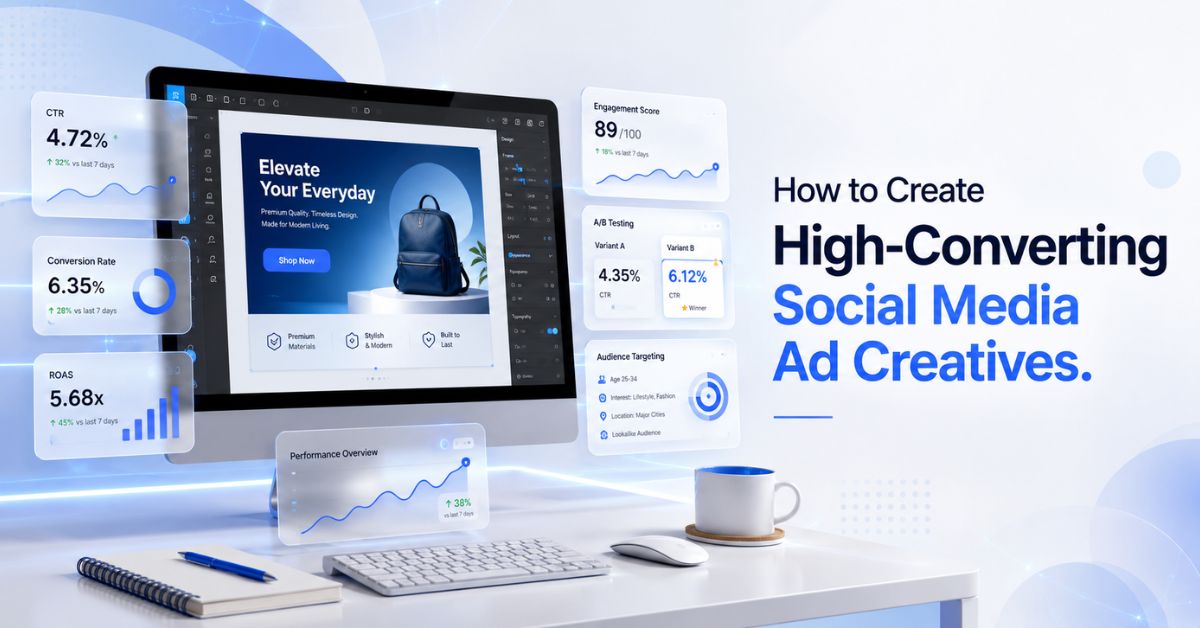
- A CTR sitting below the benchmark for your industry isn’t necessarily a targeting problem. More often, it’s a signal to test a new hook or format before touching the audience settings.
Used well, social media ad CTR benchmarks aren’t a scoreboard to obsess over. They’re a diagnostic tool that tells you whether the problem sitting in front of you is a creative one or something further down the funnel.
Testing Is What Turns Good Ads Into Great Ones
No single creative work lasts forever, and no first draft is usually the best version. The advertisers who consistently win aren’t the ones with the single best idea. They’re the ones running structured tests every week, comparing hooks, formats, and messaging until a clear pattern of what works emerges. If you haven’t built a repeatable process for these tests yet, our guide on ad creative testing strategy walks through exactly how to structure such testing without wasting budget on guesswork.
A practical testing rhythm looks something like this: run several creative variations at once, isolate one variable per test where possible (hook, thumbnail, CTA, or format), and give each version enough spend to reach a reliable sample size before concluding. Refresh creative every two to four weeks for high-spend campaigns, since even a strong ad eventually fatigues as the same audience sees it repeatedly.
Common Mistakes Worth Avoiding
A handful of errors show up again and again in underperforming campaigns:
- Treating the ad like a shrunk-down billboard instead of native platform content.
- The offer is buried behind a long brand story that most viewers never reach.
- Running one creative for months without refreshing it, even as performance quietly declines.
- Skipping the mobile preview entirely and assuming the desktop version will translate fine is another common mistake.
Bringing It All Together
Creative has become the single biggest lever that most brands aren’t pulling hard enough. The good news is that none of this requires a massive production budget. A phone camera, a clear hook, and a willingness to test relentlessly will outperform a polished but generic ad almost every time. If building and testing that pipeline in-house feels like more than your team can take on right now, a branding agency in Chennai with real experience in performance creative can shortcut the learning curve considerably, helping you land on a genuinely high-converting ad creative faster than trial and error alone ever would.