
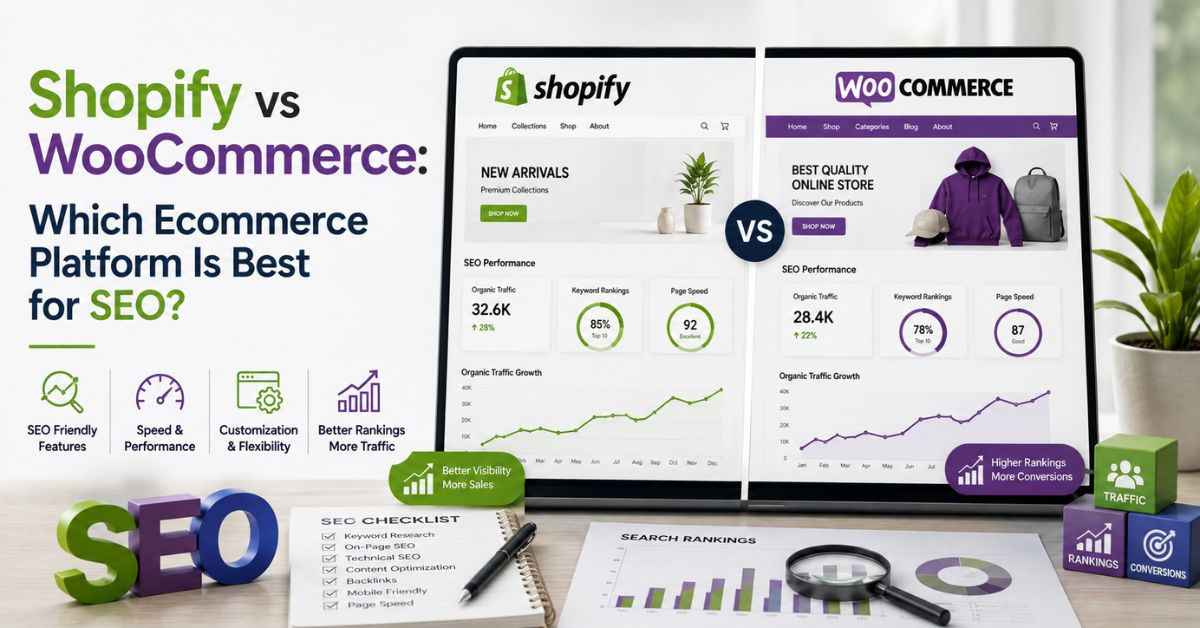
Most store owners choose an e-commerce platform based on its templates. Six months in, they realize the system they chose is either pushing their products up on Google or actively restricting them. Speed, URL control, and content management matter. You have to evaluate these features before you build out a massive product catalog.
Choosing between Shopify and WooCommerce usually comes down to these exact technical SEO constraints. Pick the wrong one, and you spend your first year fixing a bad foundation instead of actually selling. We handle SEO for both platforms at Infinix360. We know exactly where Shopify speeds up the launch process and where WooCommerce gives you necessary technical depth. This breakdown covers the real differences so you can make a choice you won’t regret.
Why the platform you pick affects your SEO before you even list a product
Search engines care about more than keywords in your product descriptions. They look at how fast your pages load, how clean your site structure is, whether your URLs make sense, and how easily they can crawl your entire catalogue. Your ecommerce platform controls a lot of that from the ground up. Change platforms later, and you often end up rebuilding your SEO foundation from scratch, not just moving files around.
How Shopify handles SEO out of the box
Shopify is built for people who want to launch fast without touching code. On the SEO side, it gets several basics right automatically.
- Clean, mobile-responsive themes that load reasonably well without extra optimisation work.
- Automatic sitemap generation and robots.txt handling, so search engines can crawl your store without manual setup.
- Built-in SSL certificates on every plan, which Google treats as a ranking signal.
- Editable meta titles, descriptions, and alt text on products and pages, without needing a developer.
Where Shopify gets restrictive is URL structure. Product URLs always include /products/ and collection URLs include /collections/, and you cannot remove that folder structure. For most stores this is a minor issue, but if you are chasing very specific URL formats for a large catalogue, it is a limitation worth knowing about upfront.
How WooCommerce handles SEO out of the box
WooCommerce runs on WordPress, and that inheritance is actually its biggest SEO advantage. WordPress was built with content and blogging in mind long before ecommerce plugins existed, and that shows.
- You get to decide your own URL structure, permalinks, and how the whole site is organised; nobody boxes you into a folder you didn’t choose.
- Plugins like Yoast and Rank Math plug straight in, and once they’re set up, you can get into schema markup, internal linking, and content details most platforms never let you touch.
- Native blogging functionality that is genuinely strong, not bolted on as an afterthought.
- Complete access to your site’s code, so a developer can optimise virtually anything.
The tradeoff is that none of this comes configured for you. WooCommerce gives you the tools, but you or your developer have to actually set them up correctly. A poorly configured WooCommerce store can perform worse for SEO than a default Shopify store, simply because there is more room to get things wrong.
Site speed: the difference that actually moves rankings
Site speed is one of the more direct ranking factors for both platforms, and it is where the comparison gets interesting.
Shopify hosts everything for you on its own infrastructure, so baseline speed is generally solid without much intervention. You cannot fully control server-level performance, but you also cannot break it through bad hosting choices.
WooCommerce speed depends entirely on your hosting, your theme, and how many plugins you have installed. A well-hosted, well-optimised WooCommerce store can outperform Shopify on speed. A poorly hosted one, loaded with unnecessary plugins, often loads noticeably slower. This is genuinely an “it depends on execution” category rather than a clear winner.
Content and blogging capability
If your SEO strategy leans on content marketing, this matters more than most people expect. WooCommerce, running on WordPress, has one of the strongest blogging and content management systems available anywhere online. Categories, tags, custom post types, internal linking- all of it works the way experienced content marketers expect.
Shopify’s blog function works, but it is noticeably more basic. It covers the essentials, yet lacks some of the finer content organisation tools that WordPress users take for granted. For stores planning to invest heavily in blog-driven SEO, this gap is worth factoring in.
Technical control: where WooCommerce pulls ahead
For anyone with development resources, WooCommerce offers far more room to customise. You can edit core files, build custom schema, restructure your entire site architecture, and install any plugin the WordPress ecosystem offers. Shopify locks a lot of this down in the name of stability and ease of use, which is a fair tradeoff for many store owners, but a real constraint for anyone chasing highly specific technical SEO goals.
Cost, maintenance, and what that means long term
Shopify charges a monthly subscription that covers hosting, security, and updates. You pay more over time, but maintenance stays mostly hands-off.
WooCommerce itself is free, but you pay for hosting, a theme, and typically several plugins, plus the ongoing work of keeping everything updated and secure. It can end up cheaper or more expensive depending on how it is set up, and it generally needs more hands-on management.
A quick side-by-side
| Factor | Shopify | WooCommerce |
| Setup speed | Fast, minimal technical work | Slower, more configuration needed |
| URL flexibility | Limited by platform structure | Fully customisable |
| Blogging and content tools | Basic but functional | Strong, WordPress native |
| Site speed | Solid by default | Depends on hosting and setup |
| Technical customisation | Limited | Extensive |
| Ongoing maintenance | Minimal | Higher, requires updates |
So which one wins for SEO?
Neither platform automatically wins. Shopify gets you a reasonably solid SEO foundation with far less setup work, which suits stores that want to launch quickly and keep maintenance simple. WooCommerce offers more technical depth and stronger content tools, but only pays off if it is configured properly, which usually means investing in proper setup and ongoing optimisation.
The honest answer is that platform choice matters less than execution. A well-optimised Shopify store will consistently outrank a poorly built WooCommerce site, and the reverse is just as true.
Final thoughts
There is no universal winner here; it depends on what actually fits your store, your team, and how much time you want to spend on maintenance. If you are unsure which platform sets your business up for stronger long-term rankings, it is worth getting an outside opinion before you build. Our team offers SEO services in Chennai covering both Shopify and WooCommerce stores, and we would rather help you choose right the first time than fix a migration later.
Frequently Asked Questions
Is Shopify or WooCommerce better for a small ecommerce store just starting?
Shopify tends to suit small stores better at the start, since it handles hosting, security, and basic SEO setup without needing a developer on hand.
Does switching from WooCommerce to Shopify hurt SEO rankings?
It can, and usually the damage isn’t from the platform itself; it’s from someone forgetting to set up redirects. Your old URLs stop existing, the new ones don’t match, and Google has to figure out where everything went. Handle the redirects properly, and most stores come through the switch fine.
Which platform loads faster?
Honestly, that’s mostly down to how it’s set up rather than the platform itself. Shopify gives you a decent baseline no matter what. WooCommerce can beat that easily on good hosting with a lean setup, or fall well behind it if someone’s stacked on ten unnecessary plugins.
Can I do proper keyword research and on-page SEO on both platforms?
Yes, meta titles, descriptions, and alt text are editable on either one. The real difference shows up once you want to go deeper. WooCommerce plugins hand you a lot more knobs to turn, whereas Shopify keeps things more guided so you’re less likely to break something by accident.
Do I need a developer to optimise WooCommerce for SEO?
Not strictly, but it helps significantly. WooCommerce’s flexibility is also where mistakes happen most easily without technical guidance.