You’ve probably heard the term thrown around in marketing meetings or read it in a blog post somewhere. But if you’ve never actually run a test, A/B testing for beginners can feel deceptively simple on the surface and oddly confusing when you try to put it into practice. This guide breaks it down clearly, without the jargon overload. Most marketers have heard of A/B testing. Far fewer actually use it. If you’re working with a digital marketing agency in Chennai, they probably already run these tests for you. If you’re not, this guide will show you exactly where to start.
So, What Exactly Is A/B Testing?
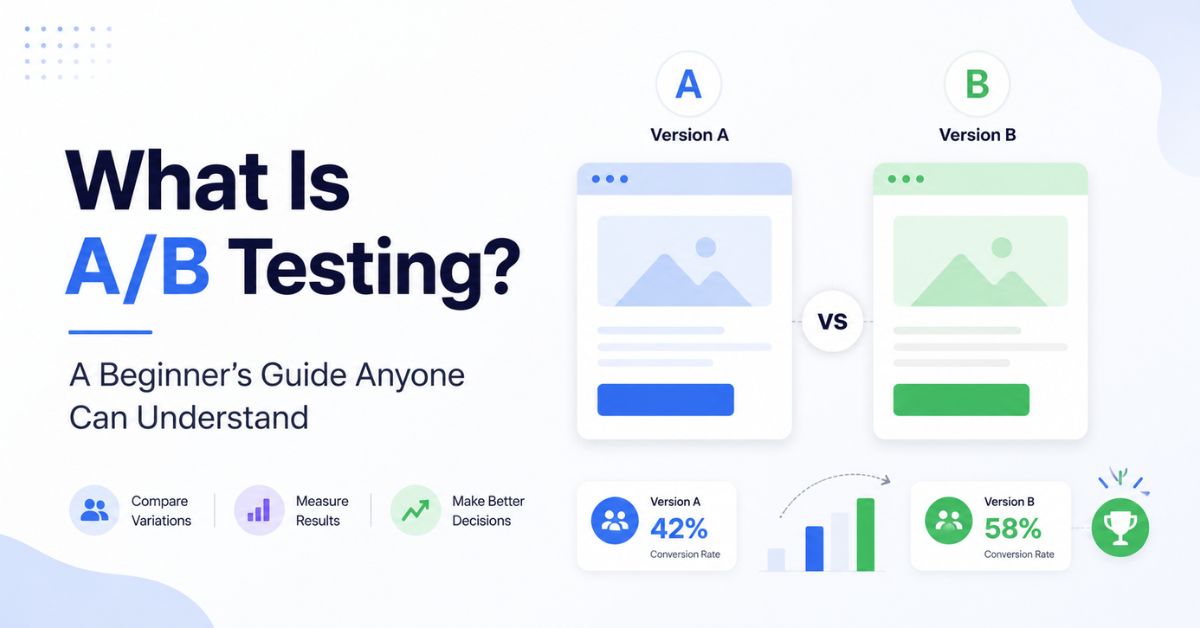
You take one thing (a webpage, an email, a button) and create two versions of it. Half your audience sees Version A, the other half sees Version B. Whichever performs better wins. That’s it. No guessing, no gut calls. Just real user behaviour telling you what works.
Version A is usually what you already have (called the control). Version B is the one with a change (called the variant). The goal is simple: let real user behaviour tell you what works, rather than guessing.
It sounds basic. And in concept, it is. But the power of A/B testing is in what it removes: opinion. Instead of debating whether a red button performs better than a green one in a team meeting, you test it. The data decides.
Why Does A/B Testing Matter?
Most websites and campaigns are built on assumptions. Someone decided the headline should say “Get Started Today” instead of “Try It Free” because it sounded more confident. Someone chose a particular image because it looked good in a mockup. These decisions aren’t wrong. They’re just untested.
A/B testing replaces assumptions with evidence. Here’s what it actually helps you do:
- Reduce wasted spend: If one version of an ad converts twice as well as another, running the weaker version costs you money every single day.
- Improve conversion rate without increasing your traffic or budget: You’re getting more out of the visitors you already have.
- Make faster decisions: Instead of deliberating over design changes for weeks, a test gives you an answer.
- Build compounding improvements: Each test teaches you something. Over months, small wins add up to significantly better performance.
What Can You A/B Test?
Almost anything that a user sees or interacts with. Some of the most common things marketers test:
On websites:
- Headlines and subheadings
- Call-to-action (CTA) button text, colour, and placement
- Hero images or videos
- Form length (fewer fields often convert better)
- Page layout and content structure
- Pricing presentation
In email marketing:
- Subject lines (this one has the highest impact per test)
- Preview text
- Send time and day
- Email length
- CTA placement
In paid ads:
- Ad copy and headlines
- Visuals or creative formats
- Audience targeting combinations
- Landing page variations
The key principle: test one variable at a time. If you change the headline, the image and the button colour simultaneously, you won’t know which change drove the result.
How Does an A/B Test Actually Work?
Here’s the basic process, step by step:
1. Start with a hypothesis. Don’t test randomly. Start with a specific question: “If I change the CTA from ‘Submit’ to ‘Get My Free Report’, will more people click?” Your hypothesis gives the test a purpose.
2. Define your success metric. What does winning look like? More clicks? More form fills? Longer time on page? Pick one primary metric before you start, not after.
3. Split your audience. Your testing tool will randomly divide visitors into two groups. Group A sees the original. Group B sees the variant. The split should be random to avoid skewed results.
4. Run the test long enough. This is where most beginners go wrong. Stopping a test after two days because one version looks like it’s winning is a mistake. You need enough data to be statistically confident. Most tests need at least one to two weeks and a few hundred conversions to be meaningful.
5. Analyse and act. Once you have a clear winner, implement the better version. Then start your next test. The process never really ends, and that’s the point.
A/B Testing and Conversion Optimisation
The real reason most brands run A/B tests is conversion optimisation: getting more of their existing traffic to take a desired action, whether that’s buying a product, filling out a contact form, downloading a resource, or signing up for a newsletter.
Conversion optimisation and A/B testing are deeply connected. Testing is the method; optimisation is the outcome. Without structured testing, conversion optimisation is just guesswork dressed up with good intentions.
A few real-world examples of what this looks like:
- An e-commerce store tests two product page layouts and finds that showing customer reviews above the fold increases purchases by 18%
- A SaaS company tests two pricing page headlines and sees a 24% lift in free trial signups from the simpler version
- A service business tests a contact form with 5 fields versus one with 3 fields, and the shorter form generates 40% more submissions
None of these brands was guessing. They were testing, measuring, and improving, which is exactly what conversion optimisation is supposed to look like.
Common A/B Testing Mistakes to Avoid
If you’re just getting started, these pitfalls will save you from drawing the wrong conclusions:
- Ending tests too early: Seeing early momentum in one version doesn’t mean it’ll hold. Wait for statistical significance.
- Testing too many things at once: One variable per test. Always.
- Ignoring your sample size: A test with 80 visitors isn’t telling you anything reliable. Volume matters.
- Not accounting for external factors: Running a test during a sale, a public holiday, or a major news event will skew your results.
- Forgetting to document: Every test is a learning opportunity. If you don’t record what you tested, what changed, and what the result was, you’ll repeat mistakes and lose institutional knowledge.
What Tools Do People Use for A/B Testing?
You don’t need a massive budget to start. Some widely used tools:
- Google Optimise (free, integrates with GA4)
- VWO (Visual Website Optimiser): good for mid-size businesses
- Optimizely: enterprise-level, highly robust
- Unbounce: built specifically for landing page testing
- Mailchimp / Klaviyo: both have built-in A/B testing for email
Most email platforms and ad managers also have native A/B testing features, so you may already have access to more than you realise.
Where to Start If You’re New to This
A/B testing for beginners doesn’t have to start with complex multi-page experiments. Pick the single most important page on your site, identify the one element that most directly affects whether someone takes action (usually the headline or CTA), and test that first.
Run one test. Learn from it. Run another. The discipline of testing regularly, even simple tests, compounds into significantly better marketing results over time.
Testing takes time, and not every team has someone to own it. That’s where a specialist steps in. Working with a social media marketing agency in Chennai means your campaigns don’t just run. They get sharper with every cycle. At infiniX360, that’s the standard. We don’t stop at traffic. We stay until it converts.