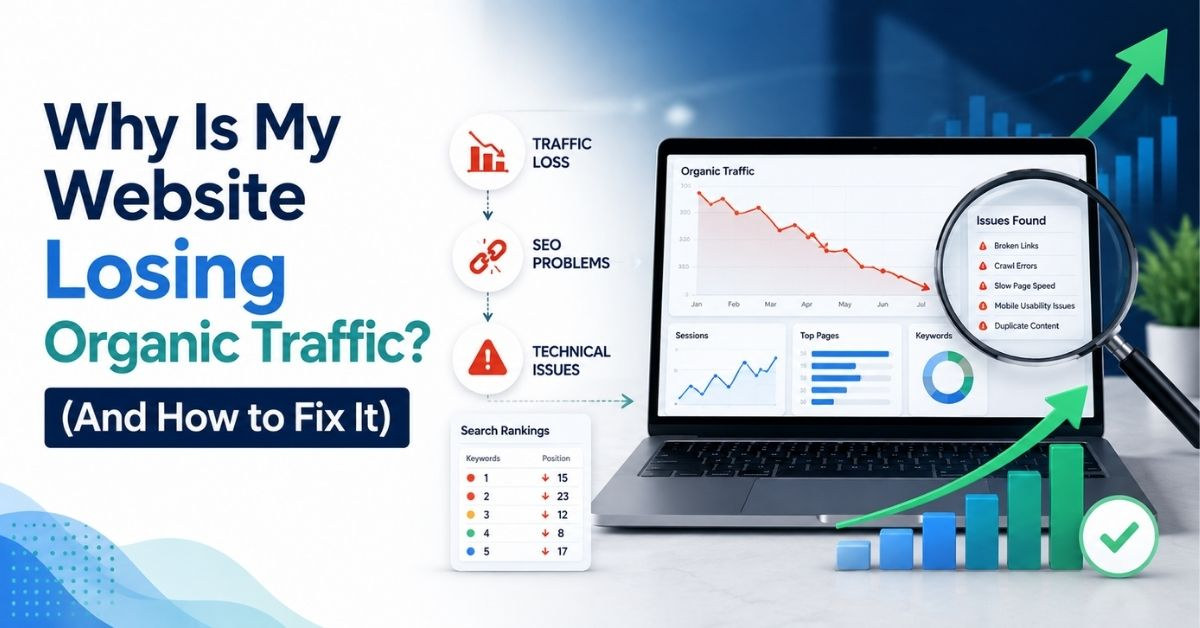
You check your analytics one morning, and the numbers just look wrong. Fewer visitors, fewer clicks, a graph that used to trend up now sliding the other way, and there’s no obvious reason why. If this sounds familiar, you’re not alone. The good news is that organic traffic drops almost always come down to a handful of causes: a Google algorithm update that changed what it rewards, technical problems like slow pages or broken links, content that’s gone stale, competitors who’ve simply built stronger trust signals, or a shift in how people search now that AI Overviews answer questions directly on the results page. As a digital marketing services provider inChennai, we see this exact pattern across client sites, and it’s seldom one single thing; it’s usually two or three of these stacking up quietly over a few months. In this post, we’ll walk through how actually to diagnose what’s dragging your traffic down, why EEAT and local SEO matter more than they used to, how AI-driven search is changing what “ranking well” even means, and the specific fixes that bring recovery. Let’s start with the causes.
The Usual Suspects Behind a Traffic Drop
Before you panic and rebuild your entire site, check these first, because one of them is almost always the culprit.
| Cause | What It Looks Like |
| Algorithm update | Sudden drop across many pages around a known Google update date |
| Technical issues | Slow load times, broken links, indexing errors, mobile display problems |
| Content decay | Older posts losing relevance, outdated stats, thinner content than newer competitors |
| Lost backlinks | Referring domains disappearing or a competitor’s link profile growing faster than yours |
| Search intent shift | People searching the same keyword but wanting a different type of answer now |
| AI Overviews eating clicks | Your keyword still ranks, but fewer people click through because the answer already showed up on the results page |
Most sites we look into have two or three of these happening together, not just one.
Google Algorithm Updates: The Silent Traffic Killer
Google rolls out core updates several times a year, and each one shifts what counts as a genuinely helpful, trustworthy page. If your traffic dropped right after a known update, check your content against Google’s own guidance on helpful content: does it show real experience, is it written by someone who actually knows the subject, and does it answer the question better than what’s already ranking? Sites that were relying on thin content or keyword stuffing tend to get hit hardest, while sites built around genuine expertise usually recover, or avoid the drop entirely.
Technical Problems That Quietly Drain Traffic
A lot of traffic loss has nothing to do with your content at all. Here’s what to check:
- Page speed. Slow-loading pages lose both rankings and visitors who won’t wait around.
- Broken links and 404 errors. These frustrate visitors and waste the crawl budget search engines give your site.
- Mobile usability. Google indexes your mobile version first, so a clunky mobile layout hurts every page.
- Indexing issues. Sometimes pages simply drop out of Google’s index due to a stray robots.txt rule or accidental noindex tag.
A technical audit usually catches these within a day, and fixing them can bring traffic back faster than any content rewrite.
Content Decay Is Real, and It’s Sneaky
Content doesn’t stay relevant forever. A blog post from three years ago might still rank on paper, but if the statistics are outdated, the advice no longer applies, or competitors have published something more thorough since, Google will quietly hand your spot to someone else. The fix isn’t always a full rewrite. Sometimes updating the numbers, adding a missing section, and refreshing the publish date is enough to pull a page back into shape.
How AI Overviews Change What “Losing Traffic” Even Means
Here’s something a lot of site owners miss: you can keep your ranking and still lose traffic, because AI Overviews now answer many questions right on the search results page. If your content doesn’t offer something beyond a quick summary, people simply won’t click through. The fix is to build content that goes deeper than what an AI summary can capture: original data, real case studies, specific examples, opinions backed by experience. That’s the kind of content AI Overviews tend to link back to instead of replacing.
EEAT and Local SEO: The Trust Layer Behind Recovery
Google’s EEAT framework, Experience, Expertise, Authoritativeness, Trustworthiness, plays a bigger role in recovery than most people expect. Adding author bios with real credentials, citing original research or data, and keeping business information accurate and consistent all send signals that your site deserves to rank. If you serve a specific city, local SEO adds another piece to the puzzle. A Google Business Profile filled out properly, pages built for the actual areas you serve, and business details that match everywhere they’re listed- none of it looks dramatic on its own, but together it’s what keeps you in the running against competitors chasing the same local searches.
How We Diagnose and Fix Traffic Drops at Infinix360
When a client comes to us with dropping traffic, we don’t start guessing. We run a full technical audit, check whether the timing lines up with a known algorithm update, look at which pages lost ground and why, and see if competitors have simply built more trust than you have. Then we put together the recovery plan: technical fixes first because they move the fastest, content updates next, and backlinks or local SEO after that for the longer game.
A traffic drop feels alarming, but it’s rarely a mystery once you know where to look. Between algorithm shifts, technical gaps, aging content, and the growing pull of AI Overviews, most recoveries come down to fixing the same handful of things in the right order. If you want a proper diagnosis instead of guesswork, our team offers SEO services in Chennai built around exactly this kind of recovery work. Reach out, and we’ll show you what’s actually going on with your site.
How do I know if my traffic drop is from a Google update?
Start by comparing the date your organic traffic or rankings dropped with Google’s confirmed search algorithm updates. If the timing lines up closely, the update may be responsible. However, also check Google Search Console, technical issues, indexing changes, manual actions, and competitor activity before assuming an algorithm update is the cause.
Can lost traffic come back on its own?
Sometimes. A temporary ranking fluctuation or a small algorithm change may correct itself as Google continues to recrawl and reassess your website. If the traffic loss is caused by weak content, technical problems, outdated information, or a loss of relevance, you will usually need to make improvements before meaningful recovery happens.
How long does traffic recovery usually take?
The timeline depends on what caused the traffic decline. Technical fixes such as indexing, crawling, or site-speed problems can sometimes show results within a few weeks. Content quality, relevance, authority, and trust-related improvements generally take longer and may require two to four months or more before the full impact becomes clear.
Is it normal for older blog posts to lose ranking over time?
Yes, it is completely normal. Search results change as content becomes outdated, competitors publish stronger resources, and user expectations evolve. An older article can gradually lose visibility if it no longer provides the most useful or up-to-date answer. Refreshing statistics, examples, references, and key sections can help keep valuable content competitive.
Do AI Overviews mean my SEO efforts are pointless now?
No. AI Overviews are changing how people discover information, but SEO is still important. The focus is increasingly on creating content that offers something beyond a generic summary, such as original research, first-hand experience, expert insights, unique data, examples, and genuinely useful solutions. Strong SEO helps your content remain discoverable while valuable original information gives people a reason to visit your website.
New content or fixing old pages, which comes first?
In most cases, start by fixing and improving your existing pages. Review pages that already have rankings, traffic, backlinks, or strong potential, then address technical problems, outdated information, content gaps, search intent, and internal linking. Once your existing content is performing as well as possible, create new content to cover valuable topics that your website does not yet address.