
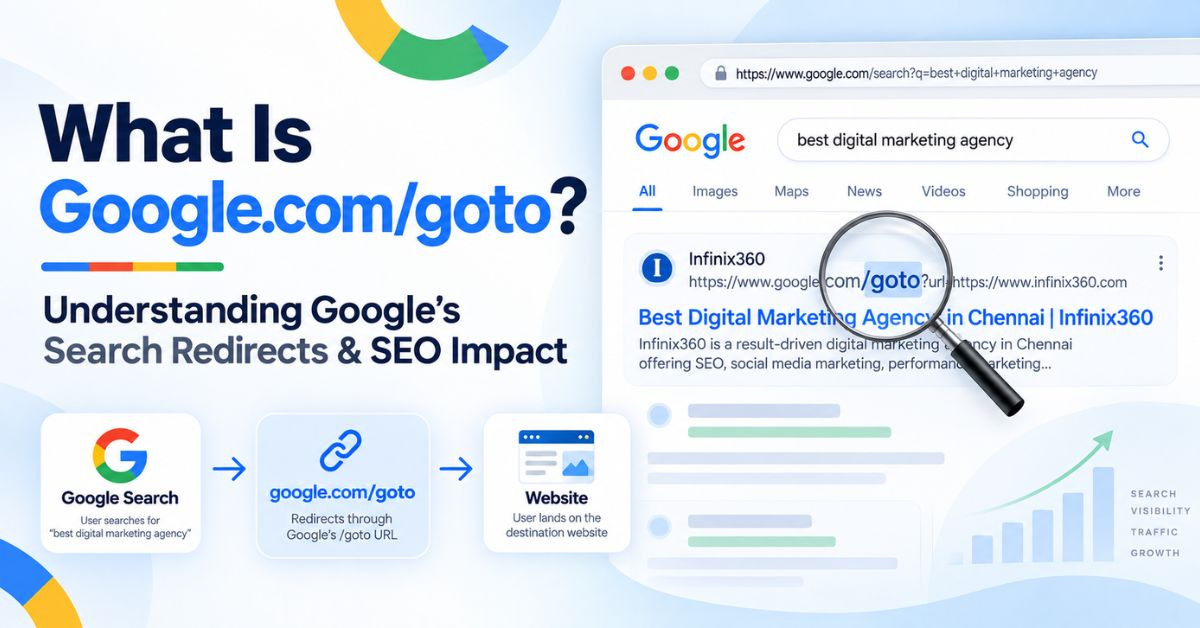
Google Search is constantly evolving, and in August 2026, Google confirmed the rollout of a new google.com/goto redirect for search result links. The change adds an extra redirect step between Google Search and the website users ultimately visit. Google said the measure is part of its efforts to protect its services and users from evolving forms of abuse.
Infinix360, one of the leading digital marketing agencies in Chennai, closely follows important Google Search and SEO developments like this to understand how they may affect businesses, SEO professionals, and search visibility.
So, what does Google.com/goto actually mean for SEO? While the change does not appear to be a ranking update, it could have implications for rank-tracking tools, SERP data collection, SEO platforms, scrapers, and AI systems that rely on reading Google Search result links.
In this blog, we explain what Google.com/goto is, how the new redirect works, why Google introduced it, whether it affects SEO rankings, and what SEO teams and website owners should do next.
What Is Google.com/goto?
Google.com/goto is an intermediate redirect URL that can appear when a user clicks a link from Google Search.
Previously, a typical organic result would point directly toward the destination website. With the new mechanism, the click can instead pass through a URL resembling:
google.com/goto?url=[encoded destination]
The browser then follows the redirect to the actual destination page.
Search Engine Land reported Google’s confirmation of the rollout on August 26, 2026. Search Engine Roundtable also documented the rollout and earlier testing of the mechanism.
Importantly, the destination website itself has not changed. The redirect is occurring within Google’s Search-to-website click path.
How Does the Google /goto Redirect Work?
The basic process looks like this:
Google Search result → google.com/goto → Destination websiteWhat is Google.com/goto?
Instead of exposing the destination URL directly as the clickable link in the search result, Google can use a /goto URL containing an encoded representation of the destination.
The exact implementation details can vary, and Google has not published a detailed technical specification explaining every aspect of the mechanism.
For searchers, the practical difference is that the browser may initially encounter a Google URL rather than the destination website’s URL.
For SEO tools, however, that intermediate step can matter because many tools collect and parse Google’s public search-result pages to identify ranking URLs.
Why Did Google Introduce the /goto Redirect?
Google has described the change as part of its broader effort to deploy technical measures against evolving forms of abuse and to protect its services and users.
Google has not publicly identified one specific company, scraper or incident as the reason for introducing /goto.
However, the change has been discussed in the context of Google’s ongoing efforts to make automated extraction of Search results more difficult. Search Engine Land specifically noted that the new redirect could create additional challenges for rank trackers, scraping systems, other third-party services and AI systems that collect Google Search results at scale.
That distinction is important:
Confirmed: Google says the change is part of its technical measures against abuse.
Industry interpretation: The redirect may make automated scraping and large-scale extraction of Search results more difficult.
Those aren’t necessarily the same thing.
Does Google.com/goto Affect SEO Rankings?
There is currently no evidence that Google.com/goto is a change to Google’s organic ranking system.
The reported change concerns how a Search result click is routed, rather than how Google calculates where a webpage appears in its results.
That means website owners shouldn’t interpret the appearance of /goto URLs as a new ranking factor or an algorithm update.
If your rankings move around at the same time that /goto rolls out, you should investigate other possible causes rather than automatically attributing the change to the redirect.
This is particularly important when analyzing ranking reports from third-party platforms.
What Does Google.com/goto Mean for Rank Tracking Tools?
This is one of the areas where the change could have a practical impact.
Rank trackers and SERP analysis platforms often need to retrieve and interpret Google Search results programmatically. If the structure of result links changes, those systems may need to adjust how they identify destination URLs.
Search Engine Land reported that SEO professionals using third-party Google tracking tools should watch their data and contact vendors if they notice unusual behavior.
For agencies, this matters because a temporary data-processing issue can look like an actual SEO performance problem.
For example:
Actual situation:Your rankings remain stable.
Tracking-tool issue:The platform has difficulty parsing the new result structure.
Reported dashboard:Ranking or URL data suddenly looks unusual.
Without checking the underlying data, it would be easy to mistake a reporting problem for an SEO problem.
What Should SEO Teams Check?
If you use third-party rank trackers or SERP tools, review your reporting stack.
1. Check Your Rank-Tracking Vendor
Ask whether the platform has updated its Google Search result parsing to account for /goto redirects.
2. Compare Different Data Sources
Compare third-party ranking data against:
- Google Search Console
- Your own analytics
- Other trusted SEO platforms
- Historical ranking data
Don’t rely on a single dashboard when investigating unusual changes.
3. Document Reporting Anomalies
If rankings suddenly change around the rollout period, record:
- Date
- Keyword
- Position
- URL
- Search location
- Device
- Tracking platform
- Search Console performance
This makes it easier to determine whether the change is real or measurement-related.
4. Inform Clients When Necessary
Agencies should avoid allowing a temporary reporting anomaly to become a misleading client conclusion.
A short explanation can prevent unnecessary concern if a third-party platform temporarily reports unusual data.
Does Google.com/goto Affect Google Search Console?
There is currently no indication that the /goto rollout changes Google Search Console’s core performance reporting.
Search Console is Google’s own reporting environment, whereas many third-party SEO tools retrieve and interpret public Search results independently.
However, Google has not published detailed technical documentation specifically explaining how /goto interacts with every Search Console reporting pipeline.
For that reason, the sensible approach is to continue monitoring Search Console while using it as an important reference point alongside third-party tools.
If a third-party ranking platform suddenly reports a major change but your Search Console data does not show a corresponding change in clicks, impressions or average position, investigate the reporting methodology before concluding that organic performance has changed.
What Does /goto Mean for Searchers?
For most people, the change should be relatively subtle.
A searcher can still:
- Enter a query.
- See Google’s results.
- Click a result.
- Reach the destination website.
The main difference is what happens between steps 3 and 4.
The clickable result may now use Google’s /goto URL before redirecting to the destination.
This can also affect how users preview links through browser interfaces. Instead of immediately seeing the destination URL as the link target, the browser may initially expose Google’s redirect URL.
The actual destination is still displayed within the Search result interface.
What About AI Systems and SERP Scrapers?
This is an area worth watching, but it should not be overstated.
Systems that collect Google Search results programmatically may need to account for the new redirect structure when identifying the final destination URL.
Search Engine Land reported that the change could make scraping more difficult for third-party services, rank trackers and AI systems that collect Search results at scale.
That does not mean every AI system will stop accessing or understanding Google Search results.
Different systems use different retrieval methods, indexes and data sources.
The practical takeaway is simply that changes to Google’s result-link structure can affect systems that depend on automated Search-result extraction.
What SEO Teams and Website Owners Should Do Now
For most website owners, there is no need to make changes to their website because of Google.com/goto.
You don’t need to:
- Change your website URLs
- Add redirects to accommodate /goto
- Modify canonical tags because of /goto
- Change your sitemap
- Rewrite your content
- Treat /goto as a ranking factor
Instead, focus on monitoring your SEO measurement systems.
Recommended checklist:
✓ Check your rank-tracking platform
Confirm that it has accounted for the new Google Search result structure.
✓ Monitor Search Console
Continue watching clicks, impressions, average position and query-level performance.
✓ Compare third-party data
If your ranking platform shows an unusual change, compare it against other data sources.
✓ Document anomalies
Keep records of unusual ranking or URL-reporting behavior around the rollout.
✓ Don’t confuse reporting changes with ranking changes
A tracking problem doesn’t necessarily mean Google has changed your website’s rankings.
✓ Continue normal technical SEO
The /goto rollout does not remove the importance of crawlability, indexability, internal linking, structured data or other technical SEO fundamentals.
If you’re reviewing those areas, an SEO audit can help identify technical and on-page issues independently of third-party rank-tracking data.
What is Google.com/goto?
Google.com/goto is an intermediate redirect mechanism that Google can use when a searcher clicks a result. The click passes through a Google URL before the browser reaches the destination website.
Why did Google add /goto to Search results?
Google says it is part of its broader technical measures against evolving forms of abuse. Industry reporting suggests that the change may also make automated collection of Google Search results more difficult.
Does Google.com/goto affect website rankings?
There is currently no evidence that /goto is a ranking-system change. It changes the route taken by a Search-result click rather than the ranking position of a website.
Does Google.com/goto affect Google Search Console?
There is currently no indication that the rollout changes Search Console’s core performance reporting. Website owners should nevertheless compare Search Console data with third-party SEO platforms when investigating unusual reporting changes.
Can users still see where a Google result leads?
Yes. The destination website remains visible in the Search result interface. However, the browser’s initial link target may now point to Google’s /goto URL rather than directly to the destination.
Does /goto mean Google is blocking SEO tools?
Not necessarily. The change may make automated Search-result extraction more complicated, but different SEO platforms can respond differently depending on how they collect and process Google’s results.
Do website owners need to change anything?
For most websites, no. There is no need to modify your site’s URLs, redirects, sitemap, or canonical tags specifically because of Google’s /goto mechanism.
What Google.com/goto Means for SEO in Practice
Google.com’s /goto redirect is a technical change to how Search-result clicks are routed, not a confirmed change to Google’s ranking algorithm.
Google has confirmed the rollout as part of its broader technical measures against evolving forms of abuse. At the same time, SEO industry reporting indicates that the new redirect could create additional challenges for systems that depend on collecting and parsing Google Search results.
For website owners, the response is relatively straightforward: don’t change your SEO strategy because of /goto.
Instead, pay closer attention to the reliability of the tools you use to measure SEO performance.
For agencies, this is particularly important. Ranking data is only useful when the methodology behind it is reliable. If a platform changes the way it processes Google Search results, understanding that change helps prevent reporting anomalies from being mistaken for genuine organic-performance changes.
At Infinix360, we monitor changes across Google Search as part of our broader SEO approach. If you want to evaluate your website’s technical health, search visibility and organic performance, explore ourSEO services in Chennai to assess the areas that can be improved.