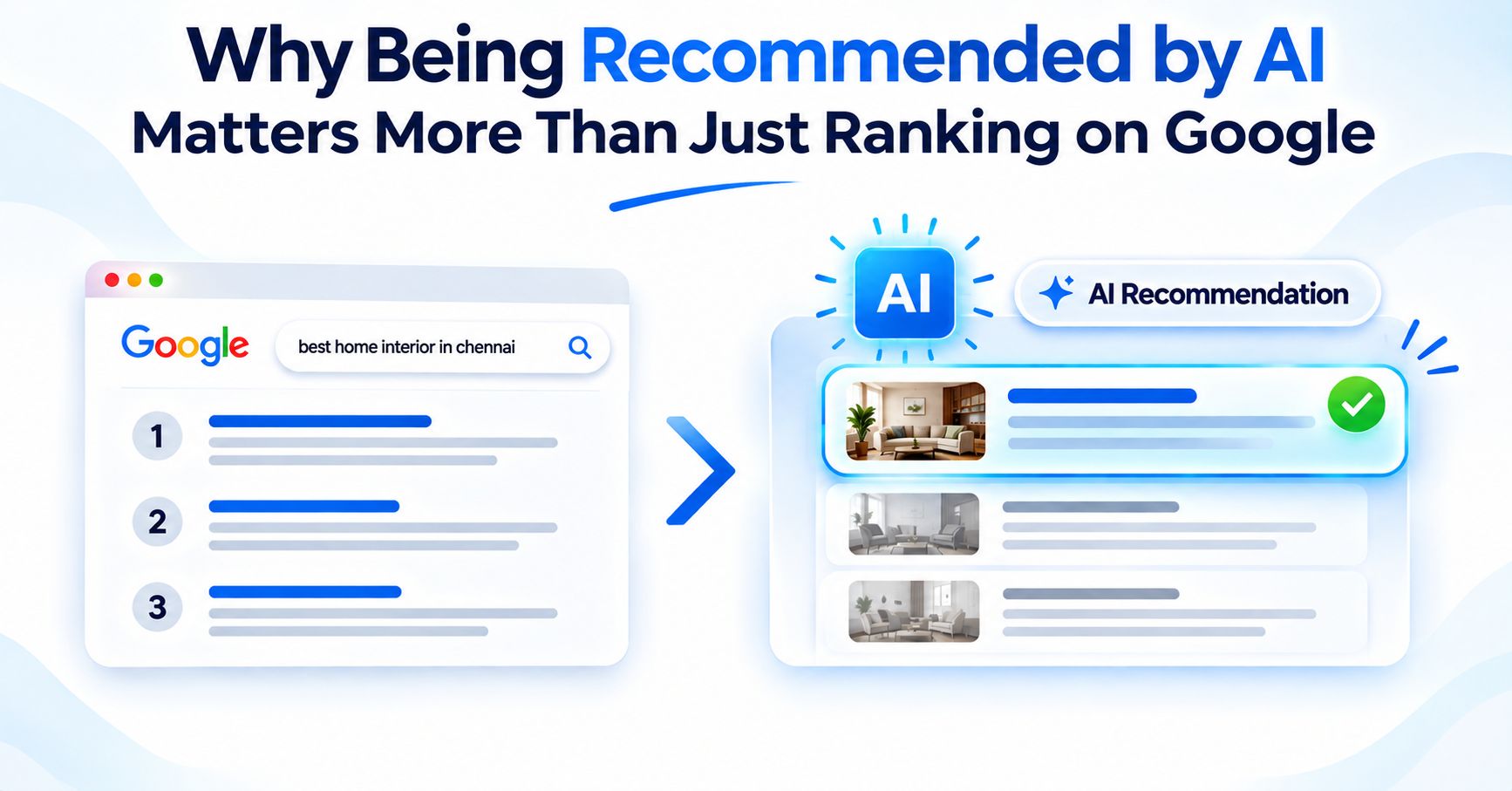
In the audits we run at Infinix360, a Digital Marketing agency in Chennai, a page in the top three for a service keyword frequently goes unmentioned when someone types the same question into ChatGPT or Gemini. Google shows a list of links and the searcher picks one. An AI assistant picks for the searcher, usually naming two or three businesses with a reason for each. The names it chooses come from what your website says, how consistently your listings repeat it, what customers write in reviews, and what other publications say about you. Rankings still bring your pages into that process, but they stop short of getting you named. This article covers how the two differ, where assistants find their information, what a missed recommendation costs, and how we test and improve it for clients.
Ranking and Recommendation Measure Different Things
Average position and impressions tell you how often a link to your site appeared. They say nothing about whether an assistant considered your business a good answer. We have seen businesses with steady rankings lose enquiries on queries where an AI answer now sits above the results and names a competitor, and their ranking reports looked healthy the whole time.
Where Assistants Get the Names They Recommend
Assistants draw on a limited set of sources and give weight to agreement between them. Your service pages supply the description of what you do, and pages that answer a specific question directly under each heading are easier for an assistant to quote. Your Google Business Profile and directory listings supply the facts: name, address, phone number, and categories. Reviews add evidence from customers, particularly the ones that name a service and a neighbourhood. Articles on industry and local sites give independent confirmation.
When the sources disagree, confidence drops. One old directory entry with a previous phone number is enough to cause it, and we find entries like that regularly in first audits.
What a Missed Recommendation Costs
A buyer asks an assistant for the best interior designers in Anna Nagar and receives three names with a sentence on each. If you are not one of them, your ranking for that phrase has little chance to help, because the enquiry goes to a competitor before anyone opens your page.
Analytics shows this indirectly. Organic clicks on informational queries fall, branded searches shift, and position reports show no change that explains it. Businesses that track only rankings usually conclude that nothing happened.
How We Build and Test Recommendation Signals
We work in this order because each step depends on the one before it.
- We write a fixed set of questions your customers ask and run them through ChatGPT, Gemini, Perplexity, and Google AI Overviews, recording which businesses each answer names and which pages it cites.
- We correct your business name, address, phone number, categories, and service descriptions so they match on your website, your Google Business Profile, and every directory that lists you.
- We rewrite service pages so the first sentences under each heading answer the question in the heading, and we add specifics on process, cost factors, and the areas you serve.
- We add Organization, LocalBusiness, Service, and FAQPage markup and validate it in Google’s Rich Results Test.
- We pursue coverage on industry publications and local sites, then repeat the test every month to see what changed.
The first test usually shows which step carries the most weight for you. A business with clean listings often has its gap in page content, while one with several outdated directory entries has it in business information.
How to Run a Basic Check Yourself
You can run a smaller version of the test in under an hour. Write ten questions a customer would ask before buying, using plain language and your city, such as which accounting firm in Chennai handles GST filing for small manufacturers. Enter each into ChatGPT, Gemini, Perplexity, and Google, and note every business named. Repeat monthly, because answers change when models and indexes update.
Conclusion
Rankings remain the entry point, since assistants read pages that search engines already index. They do not guarantee a mention. A mention follows from consistent information across your website, listings, reviews, and publications. A Branding Agency In Chennai that treats positioning, messaging, and search visibility as one workstream keeps that information aligned, and we apply that approach across our engagements. Your ten-question results will show how far your business currently is from being named.
Does ranking on Google still matter if AI tools make recommendations?
Ranking still matters because AI search features retrieve pages from search indexes, and a page that does not rank has a lower chance of appearing in an answer. Once your page is in that pool, business information, reviews, and third-party mentions influence whether the assistant names you.
How long does it take to appear in AI recommendations?
Corrections to listings and pages can appear in AI answers within a few weeks once search engines recrawl them. Third-party coverage takes longer to build. Nobody controls AI outputs, so we report month-by-month changes in how often your business is named and make no promise about a position.
Can a small local business get recommended by AI tools?
Yes. Local queries often return specific small businesses, since assistants draw on Google Business Profile data, reviews, and local pages. A clinic with accurate listings, detailed reviews, and a service page for each area can appear next to a larger chain.
Which AI platforms should a business monitor?
We test ChatGPT, Gemini, Perplexity, and Google AI Overviews first because they cover most consumer questions. Microsoft Copilot is worth adding for business-to-business audiences.
How do you measure whether AI recommendations are growing?
We record the share of test questions that name your business, the pages each assistant cites, and how each one describes you. We then compare those records with branded search volume and direct enquiries over time. Rank trackers do not capture any of this, so we keep a separate monthly record.